


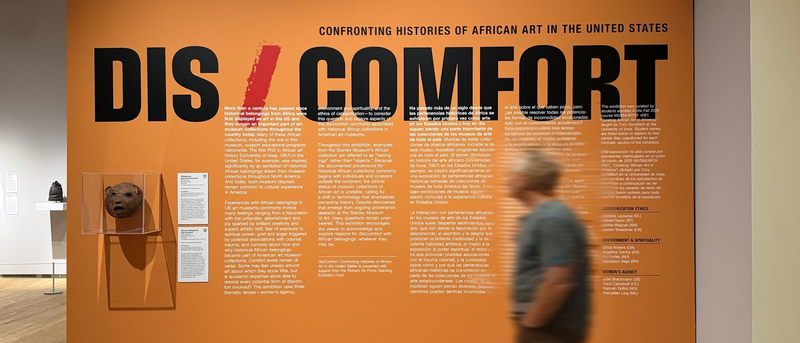
On October 15th, I had the pleasure of a guided tour through the student-curated art exhibition “Dis/Comfort,” created by a class that collaboratively uses a semester to build its own African art exhibit for the Stanley Museum, “Curating African Art for the American Museum.” Being who I am, naturally I wanted to highlight this extremely valuable opportunity to have a hand in professional curation for college students. For my class this semester, How to Write About Art, we were given the opportunity to have a guided class period through the exhibit with the help of two students who worked on this: Maryellen Lerg and Cecil Campbell.
The focus of the exhibit lies in its name. What aspects of traditional African art make Americans uncomfortable? The exhibit is divided into three major discussions, each of which is assigned to a set of students as one massive group project. These focuses are: Women’s Agency, Collection Ethics, and Environment and Spirituality. Noticeably, these are grouped by areas of African life targeted most heinously by colonialism, like gender roles and religion.
Beyond this point, I spoke with the creators as follows.
In class, you refer to racism in art history as “the elephant in the room” at the beginning of your semester. Was there pushback in class when discussing the racial bias in African art’s common provenance?
Cecil states that “To be honest, no, and that’s mostly because in classes like this, the people that are taking them understand exactly what they’re getting themselves into.”
“When you sign up to take African art history through the lens of the art museum… the more you understand that, especially when history is tied so deeply to colonialism and imperialism and violence inflicted upon African peoples, racism is really the sort of thing that you can’t ignore. But the way that people tend to approach topics like this in our current day makes people very uncomfortable. And I do think it’s sort of an elephant in the room because people don’t want to talk about it– But in our role as curators, it is something that becomes our responsibility to talk about.”
Maryellen continues, “I think the topic stemmed more from not our acceptance of these histories of the objects, but the fact that we were 14 people, mostly white Iowans trying to pull this together. And when you’re making an exhibition about white American perceptions of African art as a white American, it’s sort of like, ‘Okay, well, look in the mirror.’”
“And I think we were all a bit uneasy– Almost embarrassed to admit that we ourselves are in those shoes. But then through the work of the exhibition and finally putting a name to those feelings gave us some sort of agency that we felt we could do the work to reverse that.”
Cecil: “Yeah, it was very much coming from a place of ‘Who am I to be talking about this?’ But we knew the work was important.”
Maryellen: “And we really wanted to do it. It was more of a tiptoeing because we wanted to be so respectful.”
How would you describe the experience of seeing your curation come to life?
Maryellen: “I came in to do some promotion for the Stanley, and it was the communications person and me from the Stanley, and I walked in and immediately started crying. And I’m with a stranger, and I had to explain to her, ‘This is my first time seeing it.’ I’m just a very emotional person in general, but the monumentality of it– Obviously I knew this was going to be a thing, but we didn’t know that all of our original writings were going to be used, so then to see mine and my peers’ initials slapped all over these wall labels was like, we did this thing. I don’t know– It was crazy to see in person.”
Cecil: “Part of the thing with curating an exhibition is that it’s a very incremental process. We talked a lot about all of the minute details that go into putting together something like this, and that’s because you’re focusing on minute details for months at a time. Even the font that you choose to put on a wall label becomes the sort of discussion that can and has taken up a full week. You can really get into these details.”
“So to come here into this physical space and to really see all of this be real and not a hypothetical and not something we were just writing and discussing and planning out and making sketches of and hypothetically designing… to come in here and see it be physically realized is indescribable. All of these months of collaborative work that was all very new to all of us– It’s overwhelming but it’s also incredible.”
*At this point, Maryellen had to leave the conversation for a class commute.
Would you say that Curating African Art for the American Museum prepared you for professional experience in museum studies? More so than core art history classes?
Cecil: “Yes and no. I think it gave me some incredibly invaluable experience that I would not have had, had I not taken this class, in terms of curating or being a part of the curatorial process in so many aspects. But in relation to whether it was more helpful, I don’t know. We were doing something very different with this class.”
“But also the subject matter is so much more focused. We weren’t necessarily learning about every aspect of African art history throughout, like from the beginning of time to now, but we were learning about curating around history. And I would say it prepared me for the curatorial process and actually having to go through that for as long as it actually takes. Most of all, it definitely got me used to reading a lot of dense literature.
Can you describe to me the way the class assignments and class time was formatted?
Cecil: “We had class twice a week on Tuesdays and Thursdays, and there were a couple of different classrooms on the third floor of the Stanley. We had assigned readings every class, but we would walk in and different works from the Stanley collection would all in some way relate to the topic we were discussing that day and the readings we had done. We would go over the readings for a bit, and then we would discuss the culture behind the works of art that we were seeing on the table.”
“And obviously we discussed a lot of the cultural practices that they were known for that related to them. But also the history of the collection and the art collector. We would especially discuss the art trade and African art trade and its place in influencing other movements.”
“Famously, African art had a significant influence on Picasso and Cubism, but also many different European avant-garde movements– that was something we discussed a lot: African art’s influence on aspects of Western art and Western culture.”
In the class tour earlier, you mentioned that everything you see in a museum exhibit is intentional and everything had to be agreed on, but was it difficult for 14 people to come to consensus?
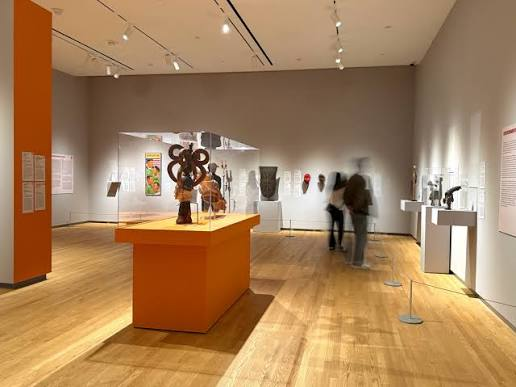
Cecil: “Not as difficult as you would expect it to be because while fourteen seems like a lot when you’re making something like this, this exhibit is made up of three sections. And there were really only like two things we had to agree on collectively. And that was, like, wall color and the fonts—and of course which objects were to be displayed in the round or our anchor objects. But a lot of the decisions were made in our three little groups that we had, curating different sections of the exhibit within this big class. So I think delegating all of those decisions to different people and spreading it out made it a lot easier to work together. We were mostly concerned with our sections and didn’t have time to worry about what anyone else was doing.”
“And we all knew each other, so I feel like if somebody had an idea that we all really agreed on, it didn’t matter that it was one person’s idea because it collectively became the idea of the exhibit. Speaking of which, everybody agreed with the idea to put the mask right in front of the entrance because it was such an important item to be displayed, and we thought it would be better there than in the round.”
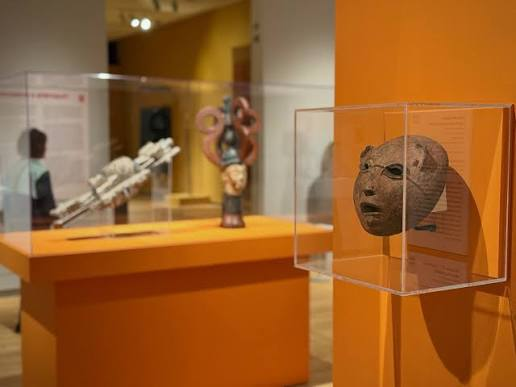
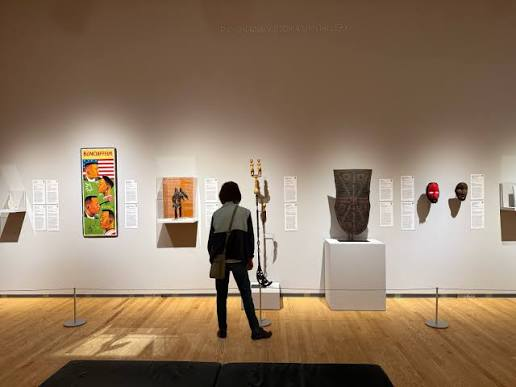
The University of Iowa is the first university to ever offer a PhD program in African Art, but the Stanley Museum was built around Betty Stanley’s fascination with African art. At this exhibit, you can view artifacts that have never been shown on display, as well as the first item Betty Stanley ever collected, a pair of bangles.
“Dis/comfort: Confronting Histories of African Art in the United States” is on display until Spring 2027.
Stay tuned in with KRUI
Programming features, updates, special events, and more delivered right to you