


Jason Shaver begins climbing a ladder inside Allstate Arena. With every step, he makes sure he doesn’t scuff his shoes. He’s walking up slowly this time, as he doesn’t want to step on his purple and pink striped tie, and his charcoal grey suit can’t get caught on the railing. He’ll be on camera today, so the extra seconds are worth it.
He’s been doing this for the last eighteen years. Since 2008, Shaver has climbed that same ladder and across a wooden bridge that looks like it could collapse if you took a bad step. After one sharp right turn and about thirty feet later, a high-top chair, a headset and a monitor wait for him. He happily adds to the clutter, as he props up spot sheets, team notes, and ad reads among other things.
On the surface, if you were a Chicago Wolves fan watching this game versus the Texas Stars on FOX+ Chicago or AHLTV, one of your thoughts would probably be that the play-by-play announcer sounds like he has found his calling; as if this has been his destiny his entire life.
While that first part may be true, the second part is anything but.
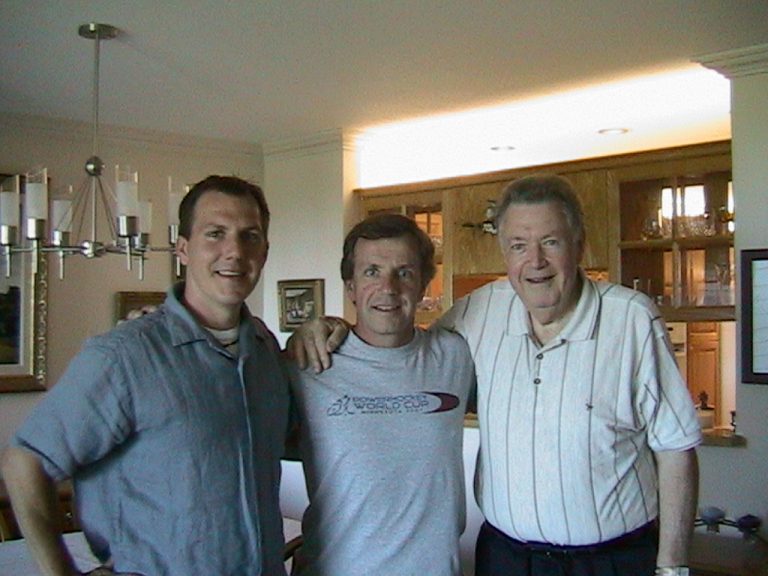
Shaver is a third-generation sports broadcaster, as his father, Wally, still calls the University of Minnesota’s hockey games on radio, while his grandfather, Al, is in the Hockey Hall of Fame for the work he did with the Minnesota North Stars since they joined the NHL in 1967. Jason was initially uninterested in the idea of being like his father and grandfather.
“When you’re a kid, your first thought isn’t to follow in your father’s footsteps,” Shaver said. “The free games were always nice, but broadcasting never occurred to me.”
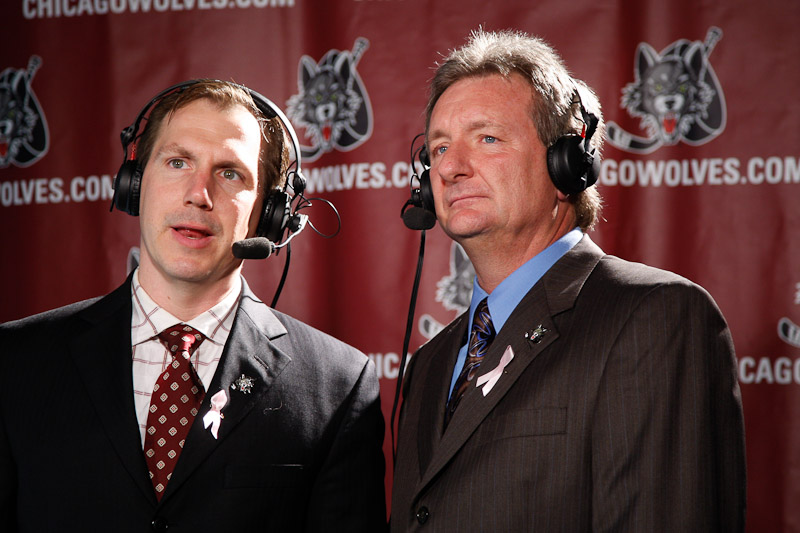
Most home Wolves games have the same routine: Shaver and his broadcast partner, color analyst Bill Gardner, have an opening segment where they share their initial thoughts on the matchup taking place. What follows is the in-arena pregame intro, starting lineups, and Chicago legend Wayne Messmer’s rendition of the National Anthem. By then, Jason and Bill are back at their posts, with Bill’s setup mirroring Jason’s, as the tightness of the broadcast space doesn’t allow them to sit next to each other.
Now, it’s no surprise that Jason grew up around the sport of hockey. Not only was it a part of his family bloodline, but he played hockey his entire childhood, even while attending Augsburg University. After some time away from the sport, he eventually decided to put a headset on and give play-by-play a try.
“To my surprise, I actually really enjoyed it,” Shaver said. “I mean, I had to have enjoyed it. Look where I am today!”
He enjoyed it so much that leading into the summer before he graduated, he started bringing a tape recorder to games, some of which he wasn’t even scheduled to call, even practicing doing ad reads.
“If I messed something up, I would have to cut it and do it all over again,” Shaver said. “Welcome to the 90s.”
Jason eventually landed a job in Waterloo calling games for their United States Hockey League team (the Black Hawks), as well as their Northwoods League Baseball team (the Buck). Play-by-play wasn’t the only thing he had to do, though, as he was also the Director of Communications and Public Relations for both clubs. Using his tapes, he got his foot in the door, much like someone he unknowingly emulated and was his eventual predecessor. Pat Foley got his start with the Chicago Blackhawks in the 80s by constantly sending his tapes to their offices consisting of games he called in the stands while at Michigan State. Sandwiched in his two stints with the Blackhawks, he was the voice of the Wolves—during which they won the Calder Cup in 2008.
Shaver’s path to the Wolves was complicated, working for teams some of which are now defunct, while also having to do sales, communications, marketing, and anything else that could be deemed ‘front office.’ He even substituted the ice rink for the larger pitch and called soccer for one summer. With each new team, the other responsibilities slowly started to diminish. Now, with the Wolves, his duties outside of broadcasting are voicing TV commercials, helping with social media and website content; still mostly amenities that fall under the entertainment category.
Gardner on the other hand has been with the Wolves since 2002. He worked with Pat Foley during his time with the Wolves and played for the Blackhawks when Foley began broadcasting for them. When hearing Shaver and Gardner on the call in the present day, their chemistry is palpable, almost as if they’ve been working together since 2008:
“The Stars are currently outshooting the Wolves eight to three,” Shaver recalls after a TV timeout in the middle of the first period, still no score on the board.
“I think the shots are updated now,” Gardner replies. “Wolves have six.”
“…you’re ahead of me then, Bill,” Shaver says with a smirk, which is immediately followed by Gardner’s uncontrolled laughter.
Even with the better part of a decade worth of broadcasting experience coming to Rosemont, Shaver still finds ways to reshape his craft.
For seven seasons, while still with the Wolves, Shaver was a fill-in play-by-play for the Chicago Sky, despite the fact that he had barely called basketball before. Instead of calling it a downgrade from hockey, he used it as one of his best learning experiences.
“When you don’t know a sport as well, you tend to use your color analyst as a learning tool,” said Shaver. “Not only are the fans educated, but so are you.”
Working with Gardner, he’s learned how and when to hand over the torch: “I’ve learned over time to focus on the black and white, which is what the play-by-play should be doing anyway,” Shaver said. “If Bill complains about a call, I don’t have to do the same.”
Sometimes, the line is crossed for a brief period, as Shaver asked, “when are they going to listen to their coaches?” in response to a Wolves forward electing to pass the puck instead of taking the open shot while they were down 2-0.
Other times, it’s understanding the world you’re living in and knowing your audience. Families usually tune into Wolves games, so when noting that two centers who had a faceoff percentage of 67% were going to duel in the dot late in the game, he reluctantly followed it up with, “the kids will like the ‘six-seven’ reference, the Wolves would like a goal.” They wouldn’t get another one, as they surrendered an empty net goal one minute later, and lost to the Texas Stars 3-1.
In eighteen seasons, he has seen it all. He’s watched the Wolves fanbase grow from individual diehard fans into mostly families with children, a change that he says still brings the same energy inside Allstate Arena. He’s seen the American Hockey League shift from a ‘rough and tough,’ ‘brouhaha’ infested league into a league where any line any team puts out has the same skill set. His calls bring all different facets of energy and meaning. One minute, he’s calling a random scoreless regular season game a “[Amir] Miftakhov show early in this hockey game!” The next, he’s calling the final seconds of the Calder Cup Final: “They reclaim their championship glory! The Chicago Wolves are the 2022 Calder Cup Champions, and the celebration is under way!”
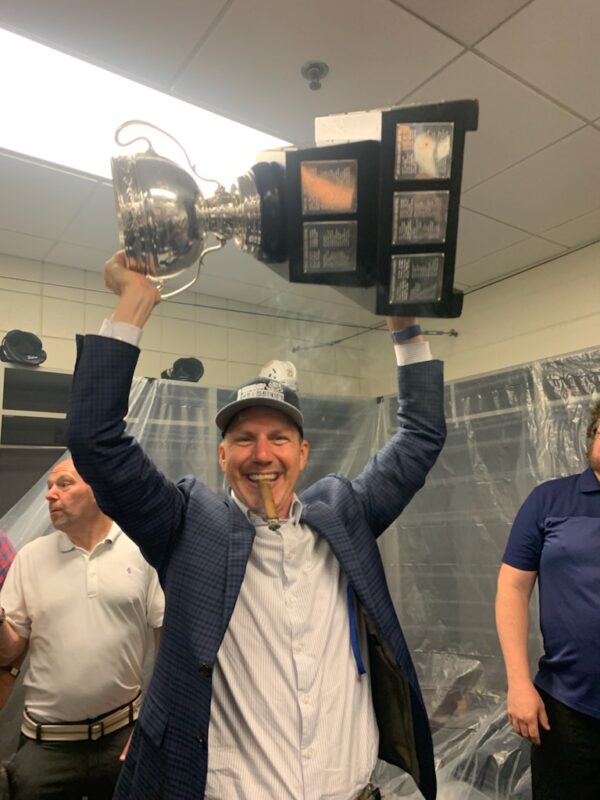
Through it all, win or lose, Shaver loves his job so much that he doesn’t consider calling games a job: “The actual job is preparing for the game; then you get to watch a hockey game for free!”
To his point, if you’re doing what you love, should it ever feel like a job? For Jason, no matter how difficult the game prep is, or how tedious the broadcast setup can be, or even how high of a climb it is on the ladder, he can let it all go from the first countdown to open the show until the moment he closes, bidding you a farewell. And he wouldn’t have it any other way.