
The 2026 Refocus Film Festival was Refocus’s fifth iteration and it certainly made a splash in Iowa City. Occurring from October 22nd to October 25th, these four days were packed to the brim with a variety of films and programs. The contributors to this article were unfortunately not able to attend all of them, but we were still grateful to experience even a taste of what Refocus had to offer.
For those unfamiliar, Refocus Film Festival is a film festival started by Ben Delgado and Andrew Sherbrune, Filmscene’s Programming Director and Executive Director plus Co-Founder. The festival showcases films, new and old, that’re adaptations, literary and beyond.
Like mentioned earlier, although we were not able to see anything, we’re here to share what we did see and hopefully capture the variety of films(and events) that Refocus brought to Iowa City this year.
One of the contributors of the article, Ria Das was able to attend five programs at Refocus. Four of those were screenings while one was a live reading event and conversation. The following will be a day-by-day breakdown of everything she saw.
Thursday
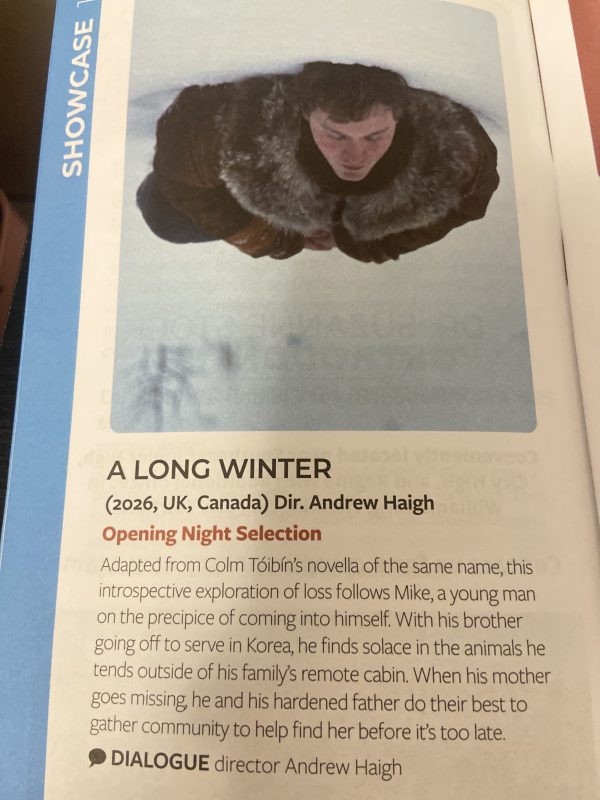
Description of A Long Winter film from Refocus pamphlet. Photo taken by Ria Das.
Refocus kicked off its opening night with a screening of the film A Long Winter. The film is an adaptation of the novella of the same name by Irish author Colm Tóibín and was directed by Andrew Haigh, who previously directed films such as All of Us, Strangers and 45 Years. The film itself follows a young man named Mike and his father coping through the Colorado winter in the mountains after his mother has mysteriously disappeared. Coming out of this film, what lingered in my mind was how the cinematography managed to capture the breath-taking nature of the Colorado setting. The setting of the mountains in Colorado ends up feeling like an additional character and we as audiences become invested in how they’ll evolve and provide challenges to our main cast. Speaking of, this main cast certainly had me shocked but definitely not disappointed. Mike, the film’s lead and played by Fred Hechinger, makes our soft-spoken protagonist someone whose emotional journey I couldn’t help be invested in and make me love. It was a struggle not being able to comfort this character but also simultaneously be awaiting what will happen next with them. The supporting cast I felt also delivered as Ebon Moss-Bachrach truly proved to me that he has range that can go beyond The Bear with his role as Mike’s Dad Lester. Furthermore, I thought D’Pharaoh Woon-A-Tai’s role as Jimmy also led to some subtle but still sweet chemistry with Hechinger. Not to give too much away, but I also found implementation of ideas on queer identity and gender into the film’s text be well written and executed in a way that I found compelling.
Following the film was a Q&A with director Andrew Haigh and conducted by Ben Delgado. Through the various questions Haigh spoke about what it was like filming up in Colorado, the film’s depiction of queer identity, and also working with the cast, especially Fred Hechinger. I remember being humored by Haigh’s funny remark about the character dynamics in the film and enjoyed getting to hear Haigh’s insights. It had been my first time ever witnessing an event like this before as it’s always interesting and very exciting to hear about a director talking about their work so candidly. Thankfully for me it would not be the last time I got to hear a creator talk about their work.
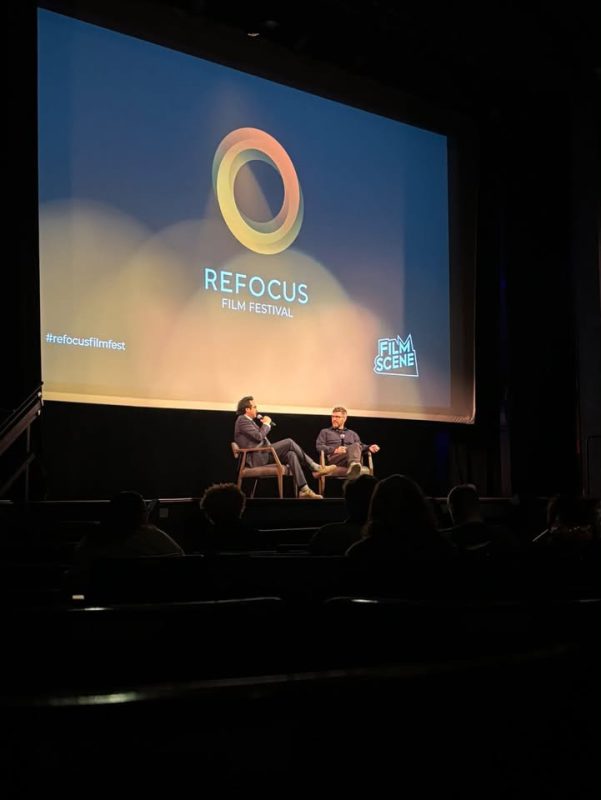
Ben Delgado hosts Q&A with Andrew Haigh. Photo taken by Naliyah Moore.
Saturday
Speaking of creators getting to the talk about their work, my first Refocus event of the day had entailed seeing Jane Schoenbrum, director of I Saw the TV Glow and recently Teenage Sex And Death at Camp Miasma, to come the Masonic Lodge to discuss their new book(which has been released) Public Access Afterworld. The event itself was a conversation between them and Rachel Yoder, author, Assistant Professor and Head of Screenwriting at the University of Iowa. Among the various things talked about, I found myself particularly interested in learning Schoenbrum’s idea for this novel that started as an actual television show but then shifted into a novel after facing rejections from networks. I found their anecdotes on why various networks rejected this show idea funny as much as the audience. There was also this very resonant anecdote they told that related to how they came up with the idea for the novel about disassociating and latching on to their favorite television shows, which is something I could connect with and definitely found to be present in their past works.
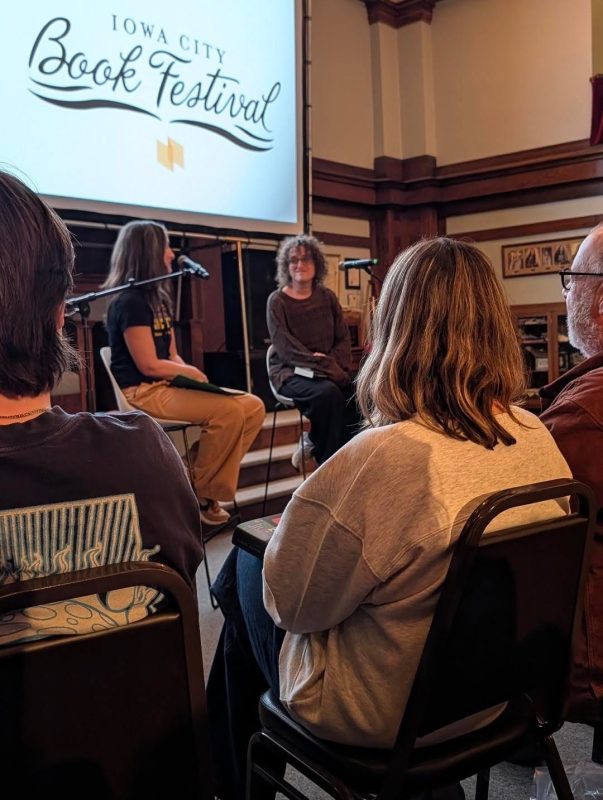
Rachel Yoder and Jane Schoenbrum in conversation. Photo taken by Alexa Priest.
Public Access Afterworld follows many perspectives who realize there’s a, “mysterious realm on the other side of our screens. A dark force that draws victims into its static. The unlikely hero called to save them and herself from this electric hell.” as described by Penguin Random House. Overall, I found myself really grateful to be in attendance and hearing a filmmaker whose work I was somewhat familiar with, talk so candidly on their process that also had some humor. I also fortunately got an early, signed copy of the novel which I’m very eager to start.
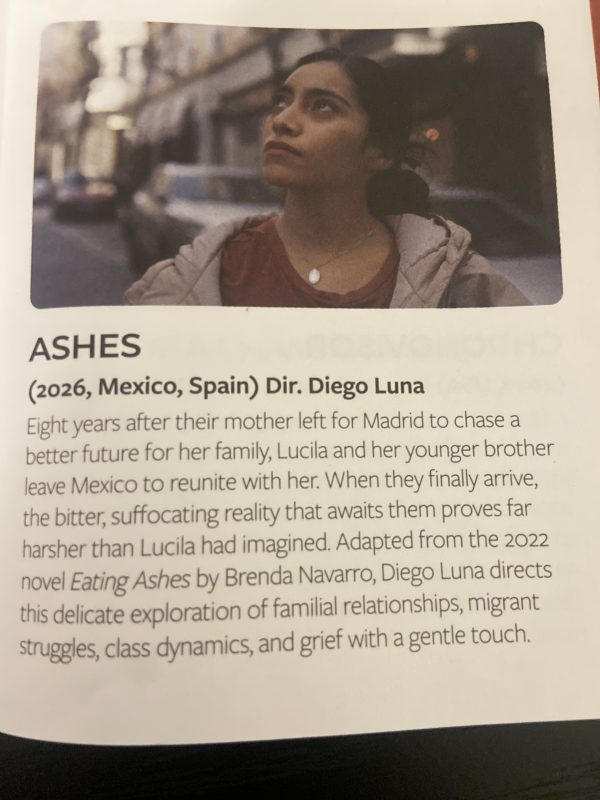
Description of Ashes film from Refocus pamphlet. Photo taken by Ria Das
Much later that day, I attended a screening of Ashes, which was directed by actor Diego Luna and is an adaptation of a novel Eating Ashes by Brenda Navarro. The film itself follows a young woman named Lucila who finds herself dissatisfied with her current mundane and empty life in Spain that was spurred by her mother’s decision to uproot them from their home country of Mexico. This movie is characterized by its slower pace with shots that linger for little longer than usually necessary, which is something I find myself liking.
However, I didn’t enjoy this film as much as I would’ve liked due to feeling like its pacing ended up hindering the story a little bit. Without revealing too much, I’ll note that I felt an element that seemed crucial to the story was introduced way too late in the story and I felt the story spent a little bit too long establishing the status quo of the protagonist as a result.
That being said, I think the film’s cinematography was quite striking in highlighting the various settings. I also think all of the actors delivered great performances and especially hats off to lead actress Anna Díaz who made me really feel for Lucila and made her read as this lost but also emotionally complex character.
To end off on a positive note, I’ll also add this film is able to capture this unique snapshot of what life can feel like at times. I don’t think I’ve ever watched a film that so perfectly can capture the flurry of what life can be like sometimes. Sometimes, as individuals we’re stuck in this mundane loop we feel like we can’t do much about. Sometimes, we can entirely uproot our lives and just leave to somewhere new, and others we’re sometimes left with just our own feelings that we’re still trying to make sense of.
Even if Ashes didn’t work all the way for me, I still felt myself still engaged in my viewing experience and I still thought the story it was trying to tell was something that I wholeheartedly respect, plus applaud all involved for being able to make it happen.
Sunday
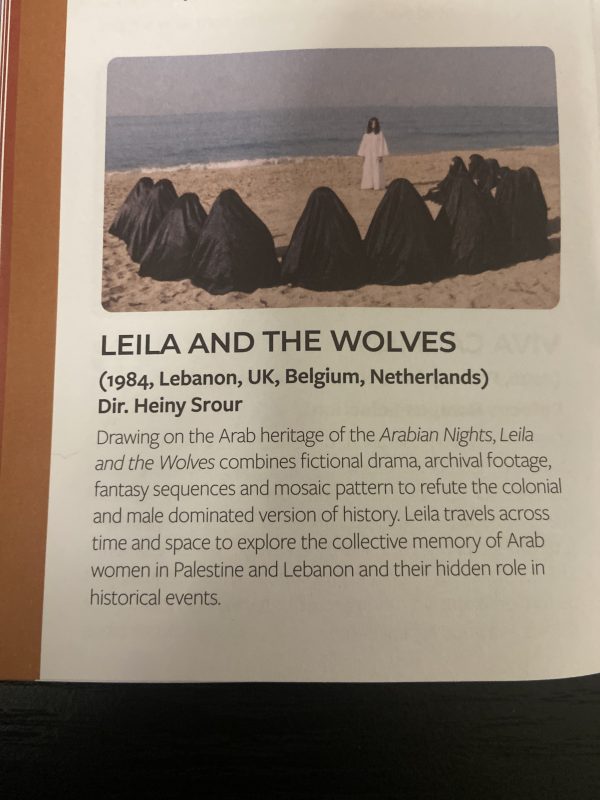
Description of Leila And The Wolves from Refocus pamphlet. Photo taken by Ria Das.
Kicking off a little later in the day, I attended a screening of the 1984 film Leila and the Wolves. The film was directed by Lebanese director Heiny Srour and it follows the fictional Leila as she examines the overlooked presence of women in revolutionary Lebanese and Palestinian history. The film is this beautiful amalgamation of re-enactments, archival footage, fictitious sequences that is based on the Arab heritage portrayed in Arabian Nights.
The only word that I can use to describe this film is important. One thing that’s always been beautiful to me about art, in general but also in film, is that it can be a way of preserving/documenting history. This film is only part real footage, but the reenactments and fictional sequences all came from a real culture that today especially is in danger of being erased and overlooked much like the women whose contributions and presence clearly were. I found myself moved by watching the pain, joy, and all the feeling in-between these women experienced as it reminded me and audiences that these are complex, human beings much all of us, far away are. I also loved the narrative framing of a woman going through this history via the exhibit she’s created for this museum she works at. It’s able to effectively incorporate every other aspect well in a way that feels immersive. Together, Leila and us, the audience are able to look through this history and see for ourselves what the reality really was. This film is definitely going to linger with me for quite some time and has made me motivated to check out Heiny Srour’s other works.
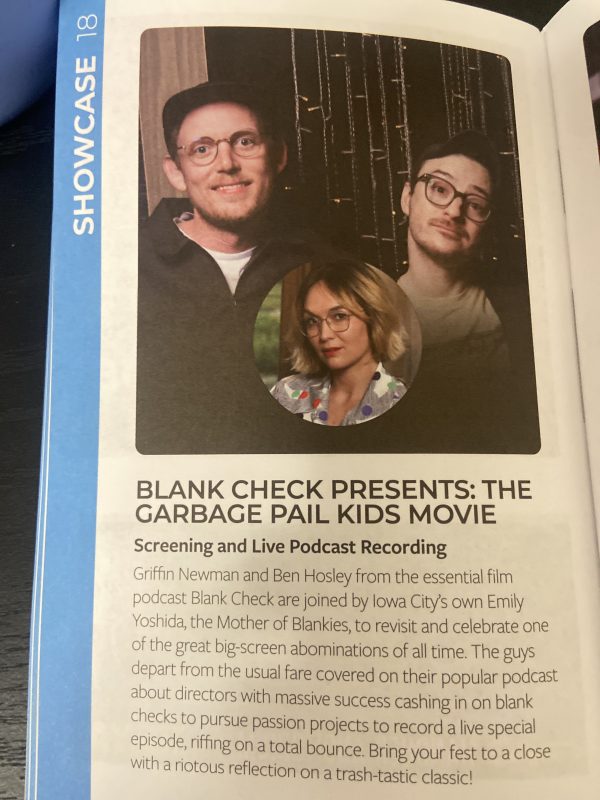
Description of Blank Check screening from Refocus pamphlet. Photo taken by Ria Das.
Finally, came the last event of the night and Refocus, a screening of the 1987 film The Garbage Pail Kids. This screening was presented by Griffin Newman and Ben Hosley of the podcast Blank Check: a podcast about the filmographies of directors who received “blank checks’ to make whatever they wanted due to earlier successes. Admittedly, a friend had recommended the event, which prompted me to finally give the podcast(which she has also recommended to me) a listen, prior to the event which I will also recommend. Honestly, this event was the one I was the most hyped for aside from the Leila and the Wolves screening and wow was I somehow still blown away.
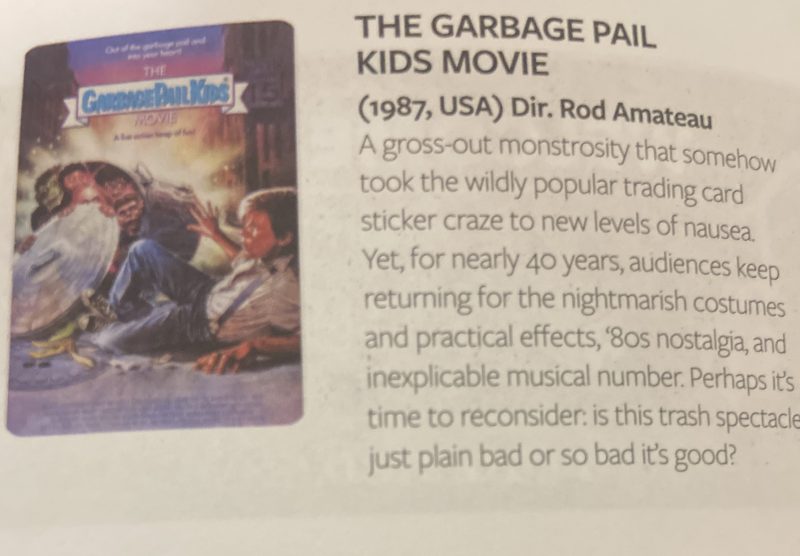
Description of The Garbage Pail Kids Movie from Refocus pamphlet. Photo taken by Ria Das.
For some context on the subject of the movie, The Garbage Pail Kids were basically parodies of these dolls known as the Cabbage Patch Kids. Essentially, they were in the form of grotesque character trading cards that you can still get together. The movie itself follows a kid named Dodger who accidentally lets the titular kids of the titular garbage pail and chaos ensues as the kids get into all sorts of trouble but still try to help Dodger win over his crush Tangerine.
The event started with the screening in the movie, which also ended up being so amazing largely due to the audience/theater experience. The Garbage Pail Kids Movie, I can’t stress this enough, is bad. On a technical level and a narrative one. There’s so many nonsensical moments that occur and the titular kids themselves are more terrifying than gross at times. However, very quickly this movie reached into so-bad-it’s-good territory that it just became a blast of a viewing experience. Getting to laugh, be disgusted, and bemoan the characters together lead to a movie watching experience that I’ll surely remember for quite a while.
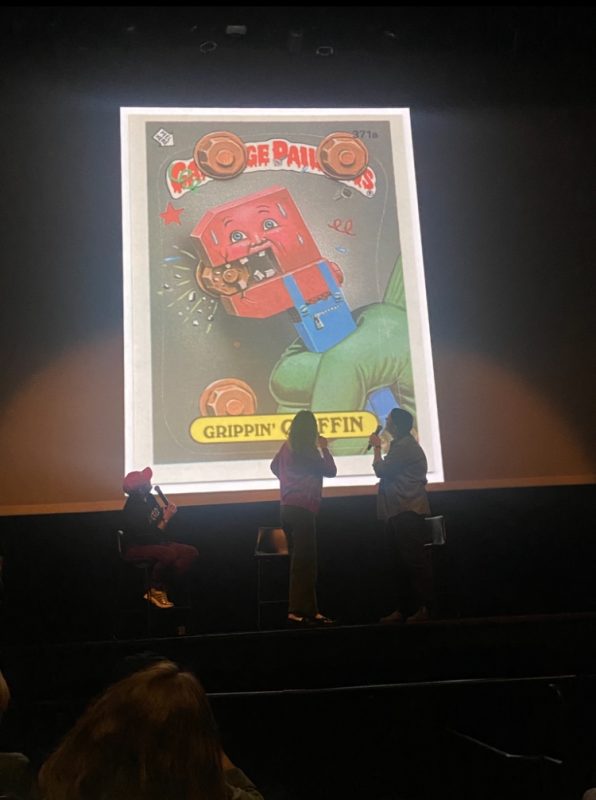
Griffin Newman, Ben Hosley, and Emily Yoshida looking at Garbage Pail Kids cards. Photo taken by Ria Das.
Graciously, near the very end of the night, the three of them opened it up to the audience to ask questions. This led to an amazing pitch for a legacy sequel that Griffin, Emily, and Ben all contributed to that came from the last question. With that, the event concluded and that closed out the 2026 Refocus Film Festival.
Truly, I don’t think there are enough words to describe how much fun it was to see the variety of programs and talent that was showcased at this festival. It was so amazing to see so much art on display and see how it can transform through adaptation. The craziest part of it all is that I only got to scratch the surface of all the fantastic work that got to be shown. This fifth year marks another successful Refocus festival and we can only hope the sixth year can match the energy brought forth by this year’s.
Stay tuned in with KRUI
Programming features, updates, special events, and more delivered right to you