



When a student dies under the university’s watch, it should become the concern of the entire student body. That is why, despite not being a member of the Hawkeye Marching Band or a student-athlete, I write today to call for more robust protocols and protections in the future to safeguard the health of some of the most dedicated and hardworking student-athletes on campus: the Hawkeye Marching Band.
It’s worth comparing what happened on September 5th to a similar tragedy that happened recently at Arizona State. This involved a draft pick, Matthew Mayich, who collapsed from heat exhaustion during an intense and hot outdoor practice. The Mayich family lawyer told The Arizona Press that Matthew had “zero chance of recovery”. The difference at Arizona State is that, according to ESPN, the school said it would form a panel of experts to make recommendations on outdoor athletic activities. Meanwhile, it appears that the University of Iowa Administration makes no move, at least none visibly, to learn anything from the death of Derek Phillips.
According to the Mayo Clinic, heatstroke happens when the body reaches a temperature of 104°F or higher. On game day, September 5th, the temperature at kickoff was 93°F. This temperature rises further on the playing field when you factor in that synthetic turf can rise to temperatures 40–70°F hotter than the surrounding air—according to Safe Healthy Playing Fields. Needless to say, the heat of the synthetic turf may have placed the temperature even further above the danger zone.

Many organizations, including the Iowa High School Athletic Association, use the wet-bulb index, which measures total heat stress on a person by combining air temperature, humidity, wind speed, sun angle, and cloud cover. Although wet-bulb guidelines vary by state, high schools in Iowa already have procedures in place. According to the Iowa High School Athletic Association, practices and contests are canceled or delayed once the wet-bulb temperature reaches 89.8°F. According to KCRG, the wet-bulb level was already 93°F at kickoff and reached a peak of 97°F during the game.
On the same day in Colorado, a Division II game between Colorado School of Mines and Washburn ended early after being pushed back several times due to the heat.
In researching what led up to September 5th, I spoke with two upperclassmen of the Hawkeye Marching Band. Both have asked to remain anonymous. To keep things from getting confusing, the first will be referred to in this article as John, and the second as Richard. These are not their real names.
Previously Dangerous Performances
Both of these marching band artists have been involved for several years. Richard detailed to me their experience during their first year in marching band, in which they played at the Iowa State Fair in 2023, which was a similarly dangerous performance to September 5th. “That was the first and only time we ever performed at the state fair, ” Richard said, ” primarily from the experience we had there.” Richard said the heat index that day was around a sweltering 103°F and that multiple band members, including Richard, had to step out of the parade due to heat exhaustion. According to Richard, other band members even passed out due to the heat. “There were a couple of golf carts riding behind us at the beginning to assist anyone who passed out, but there were more carts behind the band by the end because they had underestimated just how poorly we would take the heat that day”.
Richard went on to detail a similarly dangerous game in the cold of November 2024, when Iowa faced Nebraska. Instruments froze under the cold’s pressure and struggled to function. Each section got a box of hand warmers, beanies, and a thin coat to throw on over their uniforms. But Richard noted that:
“The director wouldn’t let us keep the coats on for the halftime performance, so we had to take a layer off while a couple of students had to be escorted to the tunnel because they were showing early signs of hypothermia. It was frustrating standing in the cold stands for the duration of the game, especially after halftime, where it would have been smart to allow the band to be dismissed at that point.”
Disaster on Gameday
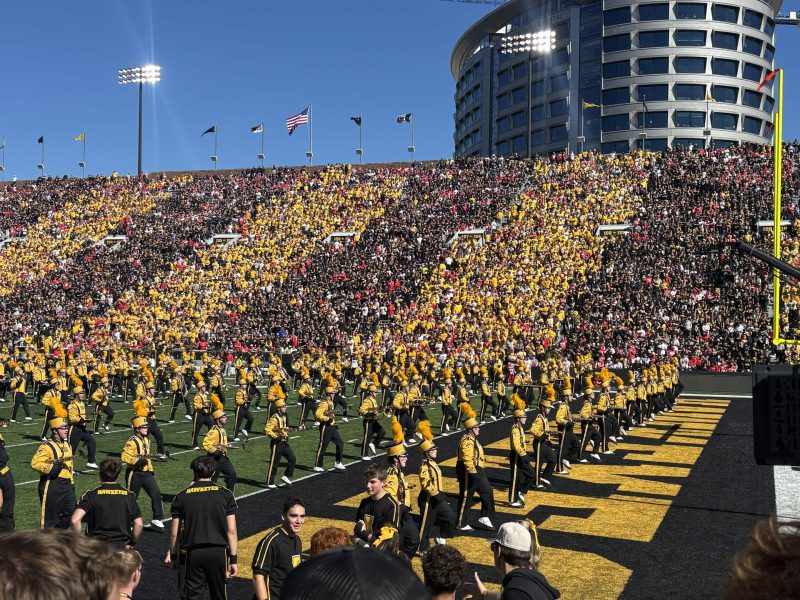
Despite these indicators of the Marching Band’s lack of protection when faced with extreme weather conditions, September 5th proved to be the worst tragedy of them all. Derek Phillips—a mellophone section leader and student at the University of Iowa—collapsed before the halftime show due to cardiac arrest. Derek would later be removed from life support, according to several publications and a post on his Instagram account made by his family—at the time of publication, the Instagram account has been made private.
“I did see medics helping a lady who was watching us as she was throwing up”. Richard said when speaking about the time before Derek collapsed on September 5th. “ When we saw that, it had started to set in just how dangerous the heat really was.”
John, the other anonymous Hawkeye Marching Band member, described the moment another band member appeared to succumb to the heat on September 5th, before the pregame performance.
“There was a freshman who was clearly suffering from heat exhaustion who set her instrument down and hobbled out of her section to the front of the band where the staff was and collapsed against the ladder in front of the audience. She couldn’t stand on her own and needed staff members on either side to move her away from the crowd and get the help she needed. I think she would’ve passed out soon if she didn’t get help. To me, that should’ve been enough that a student nearly passed out mid-performance, but they still had us carry forward into the stadium.”
Statements from the University of Iowa
It was not enough to have one student collapse. It was not enough to have seen students collapse in similarly terrible conditions years earlier. It was not even enough to have a student die. The University has seemingly refused to change its policies to protect marching band members. The University of Iowa administration’s response to the death of Derek Phillips on September 5th is careful to avoid any responsibility falling on its shoulders.
This was illustrated in the statement penned by Dr. Eric Bush and Dr. Tammie Walker titled “A Message from the Hawkeye Marching Band and the School of Music,” in which they write:
“On Saturday, September 5, a student in our Hawkeye Marching Band family experienced a significant medical emergency, and this morning he passed away”.
This statement suggests that what happened on September 5th was an unpredictable tragedy. The word emergency is often used to describe something unforeseen, but the heat conditions on September 5th, along with the band’s past experiences, made the tragedy horribly predictable.
The statement continues: “There is nothing more important than the safety of our students”.
This is a statement that struggles to hold up given the lack of safeguards in place to prevent a tragedy like this from occurring, and given their choice to hold the homecoming game as scheduled despite the dangerous conditions.
When KRUI News reached out to the University of Iowa’s public relations manager, Chris Brewer, he provided a copy-and-paste statement that was also sent to KCRG.
“Iowa Athletics has comprehensive heat-stress mitigation protocols in place to protect student-athletes during training and competitions. For event days and practices, the UI Sports Medicine staff utilizes cold tubs, cooling mist fans, cooling benches, and ice towels to keep athletes safe and respond immediately to any heat-related issues. These measures and equipment were fully in place for the football game on Sept. 5. The Hawkeye Marching Band modifies rehearsal and game day procedures when conditions warrant. While preparing for the Sept. 5 football game, HMB rehearsed indoors on Tuesday and Wednesday. Throughout the week, and during dress rehearsal at Kinnick Stadium, hydration breaks were provided three or four times per hour, and cooling towels were available for students. On Sept. 5, the band was outfitted in its alternate hot-weather uniform that included shorts, T-shirts, and ball caps, rather than the traditional marching uniform. Hydration stations and regular water breaks were available throughout the day. ”
John had this to say in response to the statement.
“We were indoors those days, but without air conditioning it was just as bad as outside, if not worse without airflow. There’s no way we got 3-4 water breaks an hour. I’d say 3 maximum, but more like 2. They did have cooling towels available for the practice. They have water jugs at the ends of the HMB stands during the game, but it’s hard to get water if you’re in the middle; you gotta pass your cup down the whole row and then have it passed back”.
Richard had this to say about water breaks.
“The two days prior to game day, we were given water breaks roughly every 20 minutes. September 5th, however, we maybe got 4 water breaks out of over 2 hours of rehearsal, so that would be about every half hour. We were provided multiple bottles of water during our lunch break, and we were handed water before we did the series, but they pretty much had to be drunk before we marched.”
Chris Brewer and the University of Iowa’s Office of Strategic Communications did not respond to further inquiries on whether the Hawkeye marching band received the same cold tubs, mist fans, cooling towels, and cooling benches that the Football team did. They also did not respond to whether or not the University or UI Sports Medicine considered extending those same services to the Hawkeye Marching Band in future games.
To learn more about the clinical aspect of heat-related illness, I decided to reach out to Dr. Christianne M. Eason, the President of Sport Safety and Education at the Korey Stringer Institute. Dr. Eason went on to detail for me what works and what doesn’t when trying to beat the heat.
Training
John noted that the band had received training in recognizing heat stroke but was unaware of any procedures for handling it beyond flagging down a trainer. The Hawkeye Marching Band syllabus and handbook notably do not include descriptions of heat-stress prevention or protocol. The closest is a reference to the athletic trainer who will “provide training to staff and students on appropriate topics (such as heat illness and prevention).” Athletes in the Hawkeye Marching Band should receive close coaching on the signs of heat stress and what to do if someone begins to suffer from heat illness. If the university wanted to hammer home the signs of heat illness, they could perhaps introduce a short online course to train students alongside the already-mentioned training from athletic trainers.

Attire
Notably, the University’s policy allowing the Hawkeye Marching Band to wear shorts, T-shirts, and ball caps rather than traditional marching regalia is an excellent measure that helps students stay cool.
This should be kept, with a procedure in place that clearly specifies the temperature(s) and/or wet-bulb index at which the lighter uniforms should be worn. KRUI News could not find any such procedure on the University of Iowa’s website or in the Hawkeye Marching Band manual.
Cooling Towels
When asked if cooling towels were an effective strategy to prevent heat illness—the Hawkeye Marching Band mentions this as one of their strategies in their previously mentioned statement—Dr. Eason told me that they served as a comfort tool more than anything else.
“Usually, if it’s really warm and humid, that’s not an effective way for cooling yourself off. The challenge is that sometimes it can make you feel cool, but your body temperature hasn’t actually gone down.” “It’s more of a comfort, but it’s not really going to do anything in terms of cooling your body down.”
Practice Environment
Notably, the Hawkeye Marching Band moved its practice indoors for two of the days leading up to the game. However, John felt this was inadequate.
“During the week, we practice at the HTRC, where our options are a turf indoor soccer field with zero air conditioning where the sun beats in from windows high on the walls, and it genuinely feels like a sauna with zero air movement, or we practice on an outdoor field a couple hundred feet away from the HTRC where there is no shade or mercy from the sun.”

Richard gave a similar testimony of the poor conditions.
“It’s important that every individual does what they can to tolerate the heat, but it’s difficult when we aren’t given enough breaks for water, and when there’s no way out of the heat for the whole day, the whole week even. We rehearsed inside the HTRC for two days that week, but that practice field also went without air conditioning, so we were always stuck in the heat.”
Although this is certainly a financial and logistical challenge, the University could consider whether there is an air-conditioned building where the marching band could practice during the hot months.
Access to Water
As for how much water artists should drink, Dr. Eason told me students should be properly hydrated before the game. Notably, the Hawkeye Marching Band already advises its artists to do this, but she said the best recommendation is 16 ounces of water per hour, or 16 ounces for every pound of sweat that you lose.
Upperclassman marching band member John described their experience with hydration during the game as follows.

“We head out pretty fast to march into Kinnick, where we wait in the tunnel, which has zero AC and is unbelievably stuffy. There are no water fountains, so there is no water for us. We then go onto the field to do our pregame performance, which is about 7 minutes long and very physically intense. After that, we get into the end zone to stand idle but play stuff like the Star-Spangled Banner. No water between pregame and that. Once that’s finally over, we get into the stands, where we got one room-temperature Powerade and a cup (not a bottle) of water that comes from water jugs at the ends of the stands. So, once you were done with the water, you had to pass the cup back down all the way to the end to get someone to fill it up again.”
I asked Dr. Eason if this was an effective strategy.
“In that situation, you almost wonder, could the artists have had individual water bottles in front of them? So all they have to do is bend down and pick them up. I’ve been to numerous football games with marching bands, and they never stop moving. There’s always something going on, and they have to be paying attention. So, thinking about needing to ask someone for water, it’s just the less you have to think about it, the more you’re going to do it.”
Marching band members might be given and required to wear carabiners with water bottles attached to them, much like the ones provided on many University of Iowa study abroad programs.
Cold Water Immersion Tubs
This one may be the cheapest and most important tool the university could adopt to fight heat strokes.
“We recommend having a cold water immersion tub available for all warm-weather practices. So, in a situation where someone is overheating, the best thing is to get them in a cold tub.” “We know that if a person has an exertional heat stroke and you can get their temperature down to under 103°F within 30 minutes, the chance of survival is 100%. Cold water immersion tubs have the fastest cooling rates for that.”

I asked Dr. Eason if these are pricey or difficult-to-acquire pieces of equipment.
“No, it’s super easy. We recommend rubber tubs for sports because of athletes’ size. They’re the indestructible things that you see a lot in agriculture. It’s the 100-gallon tub, and the cost is maybe around $20. You could also use a kiddie pool if needed, but the rubber tubs are indestructible, so you could buy one and have it for 20 years. The biggest thing to consider is having access to water and ice, but in a stadium situation, that shouldn’t be hard to come by.”
Image via Shannon Clinic
In conclusion
What happened on September 5th is a tragedy that will and should ripple through the University of Iowa and especially the Hawkeye Marching Band for many years to come, but it deserves and demands to stand for longer than that. Some of these strategies are very affordable and doable, but they also need to be written into hard—and transparent—policy.
The University of Iowa has the opportunity to use September 5th as a catalyst for widespread policy change in college marching band safety by adopting some of the simple policies listed above.
There is no reason to wait. The heat is only continuing to rise around the world. The UN has acknowledged that Earth has passed the point of no return in preventing some of the worst effects of global warming. To ensure the safety of athletes in this grim future, we must adapt to this reality and implement the policies needed to keep athletes—including marching band—safe.
Audio Narration: Kade Grierson | Visuals: Kade Grierson | Photography: Devan Renes
Stay tuned in with KRUI
Programming features, updates, special events, and more delivered right to you