
On a dreary and windy Sunday afternoon, I strolled past a green river in the direction of Elston Ave. Strolling though discarded plastic gallon bottles from the Jewel with faded and smudged sharpie inscriptions like a foreshadowing “Borg Dylan”, I found the towering salt girl adorned on top of the 96 year old structure that housed thousands of pounds of salt for close to a century before thousands of people since 2023. This landmark houses not one, but two, of America’s greatest music venues, aptly named “The Salt Shed”. Somewhere that quickly made its way to the top of my favorite venues list, boasts a sleek and new place to watch the greatest bands touring today. Later that night, The Salt Shed would expand its impressive resume of artists as Frank Turner and The Sleeping Souls came to town.
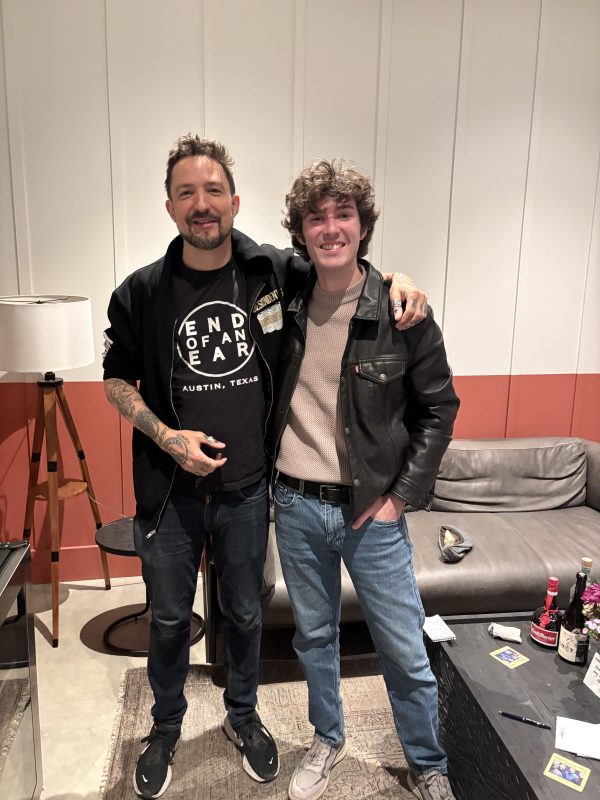
On the final night of their North American tour, co-headlining with Descendents and supported by NOBRO, I spoke with Frank Turner before this voltaic finale. This conversation danced from books to harmonicas in Green Room E before it became inhabited by NOBRO. Touching on his ever-growing library and taking a stab at guessing his most played songs, Turner spun tales of what the past has meant and what the future will hold.
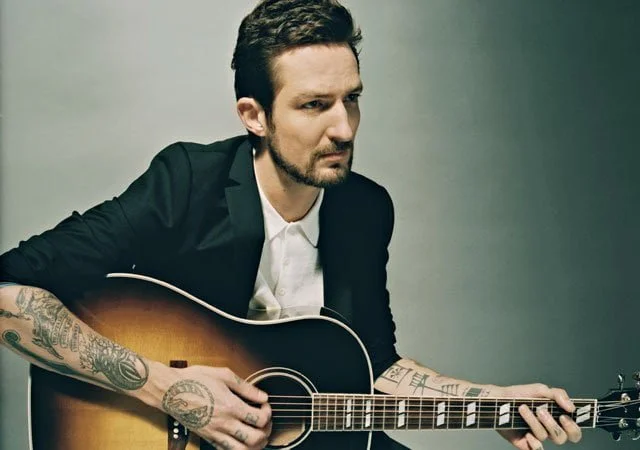
Logan Melia: So last day of work, like you’re holding up all right.
Frank Turner: Yeah, it’s been a fun run. I mean, I’ve been looking forward to this for a long time. I grew up listening to Seven’s music and we’ve been friendly for on and off over the last kind of 10, 15 years, but like, This whole tour is quite funny, like, car headlining is kind of a good thing to do in general, and my booking agent was asking me for suggestions advanced to car headline with, and I suggested Descendants, and he was like, I don’t know if it’s going to work. And I just bugged him, and I said, look, me and Stefan are really good friends, and I know the other guys as well, and I said, it’s worth a Hail Mary. You know what I mean? Send the e-mail, see what happens. So he sent me an e-mail and he called me about a day later and was like, you’re never going to guess, but they just said yes. And I was like, what? So yeah, very, very stoked about it. It’s a huge honor for me to be on this tour. And it’s been a great tour. I mean, we’ve covered a lot of ground in a short period of time. We started here, actually, but we’ve been to Connecticut and Florida and Southern California. And do you know what I mean? We’ve done a lap. So there’s been a lot of sleeping on bumpy tour buses. But yeah, we are done after today. As much as I loved it, I’m quite stoked about that.
Logan: Oh, absolutely. Put the feet up in the same spot two nights in a row, you know?
Frank: Yeah, exactly. You know, and I’ve actually been away from home for 10 weeks now because I did a tour of South America before this as well. So I’m very much looking forward to sleeping in my own bed.
Logan: Absolutely. Yeah. When you have a day off on tour, are you just crashing the whole day or are you… Are you trying to see the sights and sounds of the city?
Frank: Not so much seeing the sights and sounds, because more often than not, we have days off in kind of like a, not quite a truck stop, but pretty middle of nowhere places, because we’re generally between A and B. But I mean, I keep busy while I’m on tour. I’m mixing some records at the minute, just keeping up with work and correspondence. writing, whatever it might be. So we have a thing that on days off we call it slug life. And slug life means you wake up, you get into the hotel room, you put on the dressing gown, you put your phone on do not disturb, you order Uber Eats, and you just don’t speak to anyone all day. And given the kind of intense sociality, if you like, of what I do for a living, because I’m talking to people all day, Apart from my client, obviously, but beyond that, like on a day off, I quite often don’t talk to anyone. And that’s a good feeling. I’ll watch some Netflix really work for everybody.
Logan: Have you been watching anything good or read anything good?
Frank: I’m reading Christopher Clark’s History of the Outbreak in the First World War, which is very good. I’m a history nerd. That was a period of history I thought I knew quite a lot about, and it turns out I didn’t. So that’s been cool. I’m watching a TV show called Animal Kingdom at the moment, which is fun. It’s pretty disposable. It’s not profound, I wouldn’t have said, but I watched it and I watched the Pee Wee Herman documentary recently that was really poor. I can’t remember his real name now, but that was a really… Weirdly moving, actually. I really enjoyed that.
Logan: Do you have any pieces of media that you’ve held with you your whole life?
Frank: Yeah, I mean, the obvious thing is obviously there’s tons of records which are hugely impactful for me. I mean, that’s the thing I talk about pretty regularly. In terms of other types of media, I mean, I I read some poetry, not loads, but some. And actually recently, I’m learning Spanish at the minute, and I’ve been reading Spanish poetry, which is, I’ve been reading a lot of Spanish, which is challenging, but a good way to learn the language for sure. I mean, I read incessantly. I’m a bibliophile. My partner is always horrified by how quickly I read. And you know, recently I’ve read, I was reading John Los Passos, USA Trilogy, which is a sort of foundational American novel that’s incredibly long and hardgoing, but I enjoyed it. I think in terms of things that stayed with me over time, the book I always have to mention is Cultural Amnesia by Clive James. I think that book probably changed my outlook on life, politics, and art more than anything else I’ve ever read in my life.
Logan: How so?
Frank: I just think that Clive James has long been my favorite writer. He sat down to write a cultural traces of the 20th century and the number of people he could even think to do that is pretty limited. And I’ve read it a few times. The first time I read it, I just had a notepad out and I was like, I’ve never heard of him, never heard of her, never heard of them. Do you know what I mean?
Logan: You got homework.
Frank: Yeah, totally. And then I went and read a whole pile of books that he was sort of discussing or citing or whatever and watched films that he was talking about and listened to records he was talking about. And then sort of reread it again and had a better idea of what on earth he was talking about. But he had a kind of, I don’t know if this is quite the right way of putting it, but a kind of muscularly and humorously, but sort of self-deprecatingly sort of liberal view of the world and about sort of the need to resist totalitarianism, wherever it might come from, and all this kind of thing. So it definitely kind of gave my view of the world some sort of like hinterland, should we say?
Logan: Yeah, oh, for sure. Do you have a big library at your place?
Frank: Yeah, I do. When my partner and I moved in together, the boxes were arriving, and she was just like, this cannot be more books. And I was like, I’ve got terrible news for you, but it is. Yeah, I have a lot of books and I love them, I love keeping them there. I mean, one could argue how many, what’s the point, how many times I’m going to re-reference things. And there are a few that I do, but it makes me feel nice. I like to kind of stroke my bookshelf.
Logan: Exactly. It’s furniture, you know, it’s something for the wall.
Frank: Yeah, exactly.
Logan: A lot of books. Do you think you’ve crossed like the 500 book threshold, the 1000 book threshold?
Frank: Oh yeah. I mean, I started keeping a list of everything I read in 2020. I read an average of about 60-70 books a year. And have done since I was like 10. I don’t, unfortunately, I wish I’d started keeping this. I’m quite sort of like meticulous about stuff. I mean, you can see it from the way I count my shows and everything. Like I just, I like keeping lists of things I’ve done.
Logan: Now, speaking of kind of shows, the number I’ve written down is 3,131. Does that sound right to you?
Frank: That’s going to be tonight? I actually think it’s 3,134 tonight. I think we’ve got it. I mean, the thing about that is there are some people who think that I retain that information in my head. I absolutely don’t. It’s written on the set list. But I wrote the set list just now. So and it’s written in quite a bit. When I first did it, it was in really small letters, and I kept finding myself doing this on stage and squinting at the ball. And eventually my tour manager was like, You know, you could make that bigger. And I was like, Oh yeah, that’s a great idea. But yeah, I mean, the whole show list thing, I started doing beginning. My old drummer in my old band kept a list of our shows, and I always thought it was a bit weird while the band was together, but when we broke up, I was very glad that he did, because it gave me an overview of what we’d done. It’s amazing how quickly you forget things when you do as many of them as I do. And then also the early days of my solo touring, there was no one else there. It was just me. I was hurling on the train, I had a rucksack, I had a guitar. And so there’s no one I can call to be like, hey, what were we doing in February 2006 or something? Because there was no one else at all the shows. So I started coming to the list, put on my website. We got to show 1000 and I organized a show for it with some friends of mine in London. And I said, look, it’s my thousandth show and they were like, what? How would you know? What does that even mean? And I’m like, and I sort of explained this to them. So that one, like not that many people were on board. By the time we got to show 2000, it had become a thing that people were keen on. And we just did, we did like a 2000 cab venue in Nottingham, England, my favorite venue, Rock City. And it sold out very quickly so when it got to show 3000, we went, let’s do a big statement show. We booked Out of Sound Palace, which is like 11,000 people, thinking, maybe we’ll get it sold out by the time of the show. And then it sold out in 24 hours, and it was just like, what the what? So that was pretty cool. And now we’re on our way to 4000, and the first e-mail I had asking me where and when Show 4000 was going to be was about two days after Show 3000, and I was like, this is going to take a minute. And when I say a minute, I mean, probably about 8 years. Eight years. So, because I mean, I have done a lot of frenetics in my life. I don’t talk quite as high as I did in my sort of 20s and early 30s anymore, which is a function of age to a degree. And it’s a function of the fact that me and my band and crew, everyone’s got families now and kids and homes that they live in. I mean, back in like 20, sort of like 2010 till about 2016 was just manic. I think we did 13 months without going home at one point. And now we get to the 3 1/2 week mark and everyone’s like ‘ugh’, And then, like I say, that’s a function of getting older and it’s a marathon or a sprint. I don’t want to kill myself pretending that I’m 22 for forever. So it will take a little longer to get to the next mark, but we’ll get there.
Logan: Do you find yourself writing any differently in your new age? Do you?
Frank: Yeah, definitely. I think, I mean, writing as a concept is a very… broad and complicated and ineluctable thing. And I think that it should change. I’ve never really had a methodology for it. Songs kind of arrive and I grab at them when I can and then I spend time hammering them together. I’m sort of keen not to repeat myself, which necessarily implies change, maybe not in a methodology, but I don’t have a methodology, but like, you know, I don’t want to rewrite Love Ire and Song. I wrote that. It’s already there. Yeah, and we still play a bunch of songs with that record live. So I don’t need to write them again. You know, I’m constantly looking for ways to change what I do. And yeah, getting older does, it changes your subject matter, it changes your taste musically, all that kind of thing. So these things evolve over time. I mean, right now, it’s way too early to actually talk about this, but I’m in a very kind of like trad folk place at the moment. The last couple of records I did have been kind of punk rock records, which I love, and we’re on tour with Descendents, so happy days, but I’ve been really kind of deep into kind of old school kind of folk and country again lately. It’s been a minute since I was deep into that stuff. So we’ll see what happens. Maybe there’ll be a grind core record. I don’t know. We’ll find out.
Logan: What old kind of folk records are you listening to?
Frank: I’ve been A lot of kind of like I’ve got the Smithsonian collection of kind of field recordings of Tran-American stuff, which I love, and the Cecil Sharp House collection. as well, which is sort of the English fluent, the same thing. So I’ve been listening to all of that again. And you know, Phil Ox and stuff like that, and early Dylan and that kind of stuff. I mean, I’m not saying that I’m about to try and recreate all of that.
Logan: You’re not writing Blonde On Blonde next.
Frank: I would go early at that. I’d say more stuff like Another Side and times are a changing kind of era. I’ve been doing a lot of full band stuff lately, which I love, and I love my boys, and they’re the best band in rock and roll as far as I’m concerned, but there has always been a strand to what I do that is sort of centered around the kind of idiom of one person with an instrument. And I feel like I haven’t kind of paid too much attention to that in recent years, and I’d like to kind of refocus on it. But we’ll see. Like I said, I changed my mind radically in between albums. So there was one point when Positive Songs to Negative People was going to be a white solo album, and it absolutely isn’t. And I think everyone’s quite glad about that, but I had this moment in time when I was just listening to white soul like all the time, Style Council, whatever else, and just thinking, ‘Yeah, I want to do this’, and then, in the end, I went that, and I think everyone’s pleased.
Logan: You mentioned, you know, the number of shows you play is crazy. According to the set list out of time, I wrote down your top three most played songs and how many times you’ve played them. Do you want to take a guess as to what these three songs are and to how often? I mean, these numbers are probably wrong, but the rough estimates.
Frank: Well, I think my top three most played songs will probably be Recovery.
Logan: That’s #3.
Frank: That’s #3. My God. I Still Believe?
Logan: Number 2.
Frank: Number 2… Photosynthesis?
Logan: Number one.
Frank: Oh my God, look at that. I mean, the thing about that, that’s interesting because obviously to some degree it’s just about how long songs have been around. Photosynthesis is a much older song than recovery. That’s fascinating actually. In terms of numbers of times, I mean, the problem with it is I’m vaguely familiar with the work in the set list of FM. And somebody’s uploaded my kind of list of past shows onto it, but like the vast majority of the early ones don’t have a set list. Because no one was writing it down. And I mean, I’m sure I was writing it down. Do you know what I mean? And it’s a surprising thing. A friend of mine who runs a, there’s a festival in England called 2000 Trees, which is sort of like my home festival. I love that place. And James sent me a photo of my set list, which was written on a paper plate from like 2007 or something. And I was like, ‘huh I played that? and also in that order?’ that seems mad to me now. But, I mean, that’s one of the things that to get philosophical for a second, a show is an ephemeral thing. It happens once in one place with one stage with one group of people. And that’s one of the things I like about it. It’s not a bottleable commodity in a way, you know, it’s a moment in time. That’s what they do for a living, I create moments. And so that made sense that day. My memory of that show to the extent that I have one is that it went quite well. So good for 2007, me. The numbers of times, I mean, Photosynthesis has got to be more than 1000, right?
Logan: All three of these are over 1000. And I’ll say, one and two Photosynthesis, and I Still Believe, are only three plays apart.
Frank: That doesn’t enormously surprise me. I mean, 2000? I don’t know.
Logan: Photosynthesis 1666, I Still Believe 1663, Recovery 1377.
Frank: I mean, this is the thing. I’m actually pretty sure I’ve played photosynthesis more times than that because that song’s on my second record and I’ve played it so many times. And indeed, without giving too much away, we’ll be playing it tonight. But, and it’s a funny thing, like, I mean, there are times when people go, doesn’t that get boring or whatever. The answer to that is obviously not. I mean, it gets boring in rehearsal, because, I mean, to be honest, when we’re running a set list in rehearsal, we usually get the first instance. I play the intro and everybody goes don’t need to run that guy
Logan: Yeah, we know how to do this one.
Frank: Again, a show is not an isolated event. The whole point of it is it’s an exchange of energy and ideas with an audience. And the audience is different and tonight there’s going to be a different audience to any show I’ve ever played ever. And they will react in a slightly different way. And that means that playing this song is not boring. It’s interesting. because I mean, ultimately, if you were in a band where it didn’t matter who you were playing to, I think you’re doing it wrong. Do you know what I mean? It’s like it should absolutely matter. The audience should be part of the show, otherwise you’re basically talking to yourself. Do you know what I mean? Like, it’s a strange thing.
Logan: Yeah, Chicago. Great place. We got a Green River right now. Did you catch that?
Frank: Oh, no, I haven’t. To be honest, this is the nature of touring. I have not been anywhere other than the bus so far today. You’ve got terrible weather today as well.
Logan: Yeah, we do. We tend to.
Frank: Yeah, which we’re all a little nervous about because everyone’s supposed to be flying home tomorrow. I love Chicago, though. I mean, it’s a city I only know through touring. It’s a funny, It’s funny, some, you know, my friends back home be like, Do you know Chicago? And it’s like, I know the Aragon Ballroom. Yeah, I know the area, the Aragon Ballroom, the Metro, and blah, blah, blah, and the areas around them. I mean, this is our first time at Soul Shed. This place is rad.
Logan: This place is incredible.
Frank: It’s really cool. I mean, at the risk of sounding a tiny bit Aerosmith, like the backstage is delightful. Like they’ve, and you know, they’ve got notes for everybody on the note paper.
Logan: Yeah, custom coasters.
Frank: Yeah, custom coasters, the whole 9 yards. So, which is a nice way to finish the tour. We were in Davenport, Iowa yesterday, and everybody there was lovely, but the venue was a lot more spit and sawdust, should we say?
Logan: I’m from Chicago, that’s why I’m here, I’m a spring break now. I go to the University of Iowa, and I’ve been to the Capitol Theater a few times, and this is quite the establishment.
Frank: Yeah, it’s a different vibe. But at the same time, one of the things I always prided myself on, there’s a lot of British acts who played a handful of shows in Boston, New York, Philly, Chicago, and LA, and then go, we tried to break America and it didn’t work or whatever. And it’s just like, it’s because you barely went.
Logan: There. Well, you are in Davenport, Iowa.
Frank: Yeah, and I’ve done all 50 states. I did them all in a row.
Logan: 50 days.
Frank: Yeah, which was a terrible decision, but it’s now in the past. And we’ve played a million shows in Ohio, and we’ve been to Mississippi, and we’ve been to Portland, Maine 10 times probably, and all the rest of it. Occasionally, I do talk to friends of mine who are like, ‘how is it that you have a career over there?’ and it’s just like, dude there’s only one answer to that question, which is craft. It’s a continent. That’s like saying, Oh, we played Berlin and we didn’t break Europe. There’s more of it, you know what I mean? You’ve got to put the hours in, which is one of the things I’ve always liked about America. It’s kind of built for touring and there’s so much of it that you can just sort of keep playing around kind of indefinitely.
Logan: Yeah, for sure. My first time seeing you in 2023 at Riot Fest here in Chicago, electric set. I was waiting for Pup, which is a great little Canadian punk band.
Frank: I remember we took them on their first European tour.
Logan: Are you serious?
Frank: Yeah, I love those guys.
Logan: Yeah, and I was so stoked for them, but I got them early and I saw you, and I have a picture of me, giving them a little recap, and it’s like, Frank Turner and the Sleeping Souls, like my new favorite band.
Frank: Oh fuck yeah.
Logan: And it was just sick as hell. And I don’t remember very specifically that show you brought out Jaret Reddick. I’ve talked to before. He’s brought them up. You brought them out to, I think, play harmonica or something like that. Do you bring people out a whole lot? Do you remember that show in particular?
Frank: I do remember that show. I remember that weekend. The show itself, I remember, again, this is the thing, I remember the show going well, I remember coming off stage and feeling good about it. Do you remember that weekend where my guitar tech being an absolute, getting drunk and being an absolute terrorist backstage. He found a massive shoe, one massive shoe and put it on and just started limping around the place and the security decided that he was genuinely disabled and started carrying him around and it was just complete bedlam. I saw Tomahawk play, which was awesome. I saw Postal Service, which was cool. And I saw, actually one of the highlights that weekend is I got to watch Snapcase side of stage and I grew up with that kind of music. So I kind of vaguely know the Snapcase guys a little bit, at least Darrell. It was just, that was such a cool thing because I mean they’re not the biggest man in the world, but the lineup of people watching Snapcase from Side of Stage was impressive. It was like Ben Gibbard was there and I was there and the guys from Rise Against were all there and everything and everyone was just kind of like, you know, there was a medium-sized crowd, but you’re still looking around like, you should be paying attention to these guys. And you know, they pray. played a lot of stuff on Progressions Through Unlearning, and that made me very happy. So, happy days.
Logan: Absolutely. I kind of feel that way when I saw Helmet at Riot Fest this past year. Side stage was Tre Cool, Jack White, just like these powerhouses.
Frank: Yeah, Helmet, I haven’t seen Helmet for 20 plus years, but they’re an incredible and gigantically influential man. But to go to what you’re saying about getting people up, I mean, we do get people up on stage every now and again. I’ve never quite been the kind of loads of collabs type of guy, do you know what I mean? Like, you watch a Coldplay show or something and there’s like someone getting up every other song or whatever.
Logan: It’s Noel Gallagher up there.
Frank: Yeah, at a certain point it becomes a little bit like, check out my famous friends. And that doesn’t sit super well with me. We had a thing years ago, when I did my first arena headline show, this was in 2012. And there’s a we had a bit where someone plays harmonica, and I was kind of going through the list of kind of notable people I knew who were coming to the show, and Ricky Gervais was coming, and Daniel Radcliffe was coming, whatever. And it was just like every single one of them just felt a bit gross, no reflection on them, but just the implications of the crowd is ‘check me out I know this guy’. And in the end, we got my mum to do it, which was way cooler because she brought the house down. You know what I mean? Everyone went apeshit. I mean, we had on this tour, we were in Anaheim and my friend Mike from the effects came down and we got him up to play Harmonica on a song that he wrote, which seemed like a justifiable use of that trick. But generally speaking, I’m kind of of the opinion that if I buy a ticket to see a band, I kind of want to see them play. You know what I mean? It’s like, The occasional pop-up can be kind of cool. And I’ve seen one or two of my time. This is about as obscurantis as I’m going to get in this interview, but like, do you know Sun O? They’re the kind of doom band.
Logan: They’re coming to Iowa City.
Frank: Oh, you should go. Yeah. Take ear plugs. They are the loudest band in history. And it is more performance than it is music. But almost don’t listen to anything ahead of time. Just go down and brace yourself. Like, It’s not unlike taking acid, but I saw them play and they had Justin Broderick from Gold Flesh got up and made some extra noise for a bit. That’s probably the best way of putting it. And that excited me a lot and that was really cool. But yeah, I don’t want to overdo it.
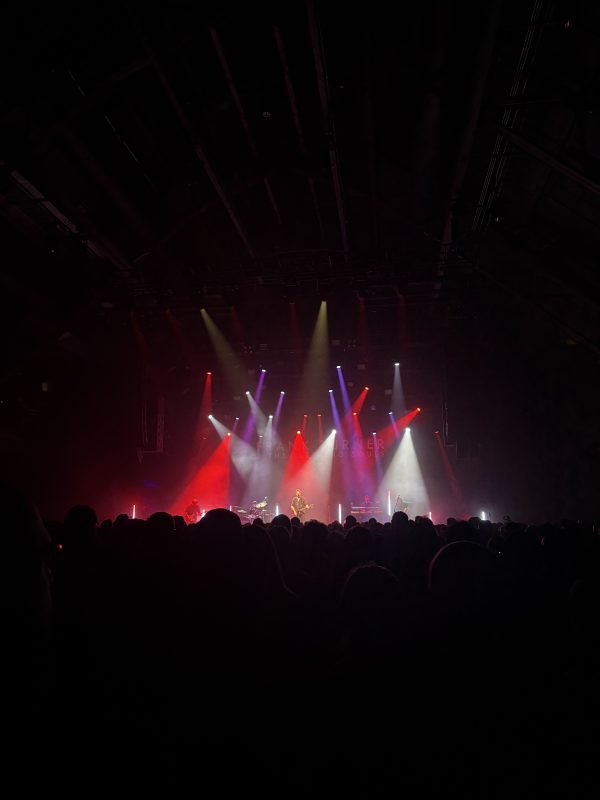
There’s never been a moment during a Frank Turner show I haven’t enjoyed. Turner promised at the beginning of the set that if they weren’t fans already, and he delivered. Between ballerina twirls and a wall of hugs (a much calmer wall of death experience), it was an intoxicating set. Support from NOBROS got the crowd energized early, as they played a stellar set including their latest single DOOMTOWN. Descendents closed the evening with 34 songs including two from their most recent LP “9th and Walnut“. This combination of artists, punks young and old, acoustic and electric, was bombastic and loud. Everything a rock and roll show should be.
Frank Turner never sleeps for long. With almost 50 shows on the books for the remainder of the year, he has time for a quick nap before he returns for a stretch of solo gigs in April and a avalanche of dates throughout 2026. You can find tickets here. Turner is also releasing an anniversary edition of his first record “Campfire Punk Rock 20” releasing on April 10th.
Stay tuned in with KRUI
Programming features, updates, special events, and more delivered right to you