

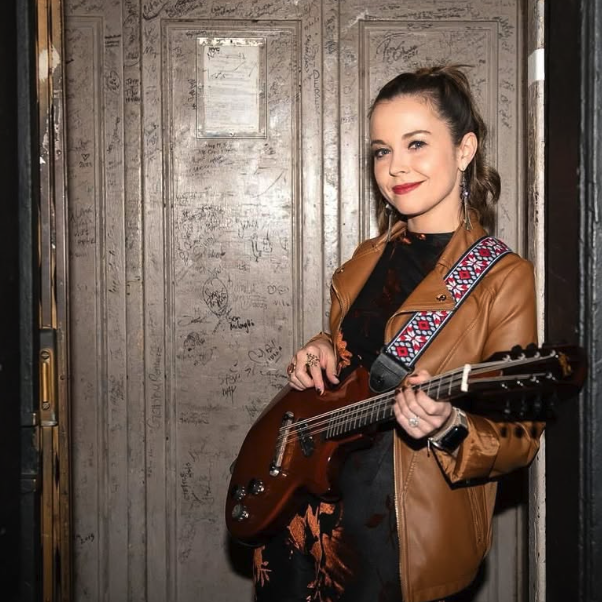
Sierra Hull is embarking on a two week long tour with The Milk Carton Kids and stopping at The Englert this Thursday on February 12th. Making a quick return from a trip to The Grammy’s that included 4 nominations, Hull took some time to talk with me ahead of this exciting tour.
Logan Melia: All right, well, you’re hitting the road with The Milk Carton Kids, do you remember the first time you all talked together? Maybe when this tour was starting to get planned out?
Sierra Hull: Well, we’ve been planning this tour for many months now, but I’ve known these guys for the better part of 10 years or more. But we’ve mostly just gotten to hang out at festivals or cross paths at various events with friends, stuff like that. We’ve never really got to do any serious music making together so I’m excited for this. We’re all kind of hopping on a bus together and just hitting the road for like two weeks and. I’ve been such a fan of theirs. They’re just like amazing singer-songwriters and musicians and I just think it’s going to be so much fun to get to kind of kick back and hear them play every night. It’s one thing to go out and sort of do your own tour, but it’s another thing when you can go do a tour with friends and be inspired every night by other people as well.
Logan: You have been so active touring this new record of yours, “A Tip Toe High Wire”, but do you remember the very first tour you ever did?
Sierra: I’ve been playing shows ever since I was a kid. I started playing mandolin when I was eight years old and playing around locally and kind of starting to do like summertime festivals where I would travel and do things here and there, but it was pretty much right after I got out of high school. I mean, as soon as I could sort of really hit the road, I started going out and actually touring more seriously. When I sort of got old enough, I could kind of go without a parent. My parents always worked full-time jobs, so there’s only so much I could do as a youngster. But yeah, I feel like I’ve been kind of touring on and off for many years now.
Logan: You mentioned growing up and always playing. And you grew up in Byrdestown, Tennessee, a real small town there. And I’ve heard legend of the Dixie Cafe being a lovely place to catch some bluegrass music. Can you attest to that statement?
Sierra: Oh yeah, the Dixie Cafe. You know, they didn’t do it when I was a kid growing up, it wasn’t a thing yet. So I didn’t like grow up playing there or anything like that. But when I got into my sort of teenage years, probably around the time I was actually like moving away, started hearing, oh, this is a regular thing and there’s jam sessions. And then it was like, oh, well, there’s people playing on stage every week and local musicians. So it just does my heart so good to know that there’s a music scene in my hometown. Because I used to have to go over to the next town, Jamestown, where a lot of my family was from, or kind of go down the road a piece to be able to find any kind of real jams or music. So I just love that The Dixie is bringing music into the community like that so cool.
Logan: Yeah and you are very much at the forefront of this huge bluegrass revival. I’m seeing it as someone who wasn’t really in the bluegrass a few years ago seeing it wash over this this whole music culture right now, and being a part of this leading charge here it seems very cool. How does the bluegrass scene seem now compared to maybe what you were growing up with, does it feel any different?
Sierra: Well, I just think the music scene, in general, the way we get our music, the way that our culture feels toward music is so different than what it was when I was a kid. I mean, but I’ve been lucky enough to kind of be really immersed in the bluegrass community since I was really young. So in a way, that community is still there. It’s thriving. It always has been, right? It’s always been a big part of my world, but it’s exciting to see it be able to reach a bigger audience in some cases. There’s always been moments I know we’ve got like the big anniversary of the “O Brother Where Art Thou” soundtrack I think hitting this year. And there’s always a wave of something like that that comes along and puts it in the spotlight. You know when I was a kid that was one of the big things, and someone like Allison Krauss kind of being at the forefront of that to see what my buddy Billy Strings is doing these days and the audiences that he’s reaching. The way that bluegrass can kind of coexist alongside a bunch of other styles of music just because I think our culture consumes music that way now, where we can get on our phone and within, 2 minutes we can curate a playlist of everything from bluegrass to hip-hop if we wanted to. So I think it definitely feels different, but I think it’s more, for me, it’s more that the culture around music just feels different. But the bluegrass scene, has always been this beautiful, thriving thing, and it’s cool to see other people start to get a glimpse into that world and that community that I’ve loved since I was a kid.
Logan: You mentioned the ability to get these wild playlists going on. Do you have anything you wouldn’t expect to be on, you know, bluegrass Grammy nominee Sierra Hull’s playlist these days?
Sierra: Oh man, I’m all over the map and what I like to listen to. I mean, it’s funny. It’s like I really enjoyed the Justin Bieber performance a lot at the Grammys.
Logan: With the loop pedal and everything?
Sierra: Yes, sitting in the room the other night, I mean, he’s such a crazy singer. And so it’s been kind of fun, even some of the things that I was in the room here on the other night, I started going, okay, cool man. Say what you want about pop music and coming from a world like bluegrass and others, a lot of people are like, Oh, I can’t stand the Grammys. That kind of thing is just not their cup of tea. But I’ve always just been someone that loves all kinds of music. And you sit in the room and you hear somebody actually sing live though, I mean, there’s no denying the level of talent in the pop. There really is some incredible singers and some incredible artists so it kind of makes me go home. Maybe I want to listen to some of this stuff that I kind of missed over the last year. I Don’t know, I bop around a lot to be honest with my listening of Joni forever, of course, but then it’s like, I kind of go, oh man, that makes me want to go back down a Joni rabbit hole. There’s so much great music to listen to, for sure.
Logan: What is the most recent rabbit hole you fell down?
Sierra: Oh, well, probably Bieber the last couple days, diving into his new record, listening to that a little bit. The total rabbit hole, oh gosh. Yeah, I don’t know. Maybe that just because that’s the last couple days. I’ve probably watched that performance four or five times over the last few days.
Logan: Do you have any memories of watching the Grammys at all growing up? Do you have any performances that have like stuck in your head?
Sierra: Oh yeah, it was always cool for me to see as a young bluegrass kid, I mean, I was so immersed in bluegrass. Of course, my friends at school were listening to the popular pop music of the time, but that really wasn’t where I was digging in my heels as a listener. It was all bluegrass, and I was such a big Allison Krauss fan. Of course, Allison’s been a staple of the Grammys for basically her entire career, and has been loved on strongly by those folks. And so anytime I would see someone like her perform, that was always really exciting to me because it felt like there was a part of my world being represented on the big stage like that.
Logan: You mentioned growing up listening to bluegrass. I saw in some older interviews you brought up how your dad brought home a Larry Sparks tape and Tony Rice and stuff like that. What would you want to show the next generation of bluegrass players right now? What would be your Larry Sparks?
Sierra: I mean, Larry Sparks is still out there crushing it, to be honest. And I think there are people like Larry, like Belle McCurry, who are still out there really holding the torch for that sort of early bluegrass sound. They’re the closest thing that we have to Ralph Stanley. It’s like you’ve got Larry, who actually played with Ralph ,and you’ve got Dale, who actually played with Bill Monroe. I mean, these guys come come at it with that first generation connection that like the rest of us don’t quite have. And for me, I think for anybody who’s really getting into bluegrass, I love, like I said, all kinds of. The music that I make obviously leans more progressive these days and a lot of what I’m tapping into too, but I mean, at the heart of it, I love that traditional music, and I wouldn’t trade sitting in those jam sessions as a kid singing that. Singing and playing the music of Flatt and Scruggs and Bill Monroe and the Stanley Brothers and growing up listening to Larry Sparks, people like that, there’s a foundation you build on that first generation music that I think is so important for a young musician who wants to grow up playing these instruments. And even if your heroes are more progressive people, I think there’s no replacement for going back and digging into where this music really comes from.
Logan: How do you find a balancing act between the two? Because I feel like you do such a good job of doing new and innovative things while also kind of holding down that old Larry Sparks charm.
Sierra: I don’t think about it that much, to be honest. I think that the foundation and that old-school thing is just a part of me. I mean, I grew up here in Tennessee, too, and that music, kind of the way even culturally, what the music was kind of built on, you know, singing about the little cabin home on the hill and, the hard times in which people, Appalachian people, were facing. It’s like, that’s kind of those stories, even though I grew up obviously in a different time, hence the fact that I think my music reflects a different kind of sound and time as well in order to feel truly authentic to me, I think it kind of has to. But those sounds are like my people, It’s a part of not only just the music I grew up listening to and playing, but the people that I was around too, and people that experienced the music, the things that those stories are all built upon, the sounds of bluegrass really just sound like the part of the world that I come from. So I think there’s the there’s that part of me that will always just reflect in the music because it truly is, as a person, who I am and where I’m from.
Logan: It’s so ingrained in kind of Tennessee, the culture of it all. Is there anything that you have learned on mandolin or about bluegrass music or anything that has recently come into your ears that you’ve been able to implement into your songs?
Sierra: I think if you’re really keeping your ears open, there’s always something to be learned and to be brought into the music. You know, I think like coming out of this kind of crazy week I just had, I think there’s a lot of inspiration to be had being in the space, and I was in Los Angeles all week for Grammy stuff. And you’re around all these incredible artists for an entire week, people who are all there celebrating all styles of music and just the love of the craft and the hard work that everybody kind of puts into this too. I know it’s like you kind of go, oh, Grammy week, it’s all about the flash and the awards and getting dressed up and all that kind of stuff. Yeah, that’s fun, that’s true, but it also is like a showing of all the hard work that all these artists put into music over the last year and sort of celebrating that. And so, I think coming home even off of that hearing, like I said, a lot of performances that were inspiring to me, conversations I had with people that were inspiring. All that really starts to get me excited to work on the next thing, so it’s always hard to put your finger on, well, something that you’ve learned directly, whether it be an exact musical phrase or just something in life that happened that inspired you. But I know I certainly feel inspired right now and a real desire to kind of be like, okay, that was fun, now let’s get back to work. Let’s get back to the actual thing we all want to do, which is making music. I came home and I said that to my husband. I was like, well, that was fun, but now I’m like, shoot, I can’t wait to get back to actually playing my instrument and singing songs.
Logan: Are you writing anything new these days? Do you often write new things casually or do you have to be in a certain mindset to like put down some new ideas?
Sierra: Yeah, the last couple days I’ve been writing like crazy. That doesn’t always mean that’s something ever going to be heard either, but gathering lyrics and ideas and feeling, I think for me, there’s moments where I can like grasp it and go, I can like connect to something like I’m always writing. But then there’s sometimes when there’s this like real inevitable feeling of I must do it, like I have to do it, and so whatever that is, I feel it right now. And that comes in waves for me. That’s not all the time. Sometimes you can think, well, it’d be good if I got back to writing because I hadn’t been doing it much, but you just don’t feel like you can work on it a little bit. But the connection, I’ve got to do this almost in a therapeutic way, is not there in the same way. And I’ve definitely been filling that pole lately. And I think that’s probably as a result too, the whirlwind of being busy and finishing one project, we put “A Tip Toe High Wire” out not quite a year ago, but almost, and you jump into this whirlwind of being so busy around new music and a new album, and then you sort of find yourself near the end of that cycle, and it’s almost like your emotional space frees up for me, where I can suddenly go, okay cool, we sort of did that thing. Now I can get back to the creative side again.
Logan: In this past year, you played the Outlaw Music Festival with such a cool variety of artists. I believe the dates I saw had Willie Nelson, Bob Dylan, Billy Strings, and Lake Street Dive, and a few others. Normally, there’s not too big of an age gap between eighty-year-old Bob Dylan and these younger artists right here. Did you learn anything from that tour being around these older artists?
Sierra: Well, getting to watch him play, I didn’t even get to meet Bob. I didn’t get to hang out with him, unfortunately, or anything and I think it’s understandable. It’s like Willie’s in his 90s. Bob turned 80, actually, while we were on the road, which is pretty cool. But getting to see him take the stage every night as these legends and when you’re on a tour with Willie and Bob, I think the main takeaway for me was man, songs. They just have songs, It’s like we all, we think about, of course, Bob Dylan probably as a songwriter first and foremost. Willie… Willie’s just such a treasure kind of all the way around, but like he has such an incredible catalog of songs and even songs he didn’t write, his ability to be a storyteller. I remember he would sing this song every night on tour called “The Last Leaf on the Tree”, and I swear I didn’t realize it was a Tom Waits song. It wasn’t a Tom Waits song that I knew, But it was like my favorite in the set every night. Just the way he sang it sounded exactly like he wrote it. I think because they’re such great songwriters and they understand the power of words and lyrics, there’s a delivery that those guys have and what they do that is just, I don’t know, it sort of stands on its own. And then the performance is just like the cherry on top, you know what I mean? So yeah, it just reminded me of like, okay, you gotta have good songs first and foremost first and foremost. All the fancy like tricks and talents of like vocal moves or instrumental whatever prowess, that’s really secondary to the song. It’s pointless without having really good songs in my opinion.
Logan: Do you have any songs that you really enjoy covering yourself?
Sierra: You were talking about that tour, we covered a couple things on that tour, most nights, we have a cover of “Mad World” we do a lot, which is one of my favorites. On sort of the flip side of that, that’s like moody, edgy, or, you know, lyrically a little bit more edgy than something just straight ahead. But then like on something just completely joyful, it’s like we would, to cover Bela Flec stomping grounds, often. So, I mean, we have a wide range of stuff. I just most recently covered, actually during Grammy’s week, the Americana folks have a kind of tradition. They do a music cares fundraiser show honoring an artist at the Troubadour every year. And this year it was Neil Young. So it’s a bunch of artists singing Neil Young songs and I did the song “Look Out for My Love”, which is such a great song. And yeah, such a great catalog of songs he has to.
Logan: You went to the Berklee College of Music, and I’m in college right now. Was there any party that wanted a more traditional college experience? Because obviously Berklee’s a little intensive, one might say. Do you at all wish it was a little bit more of the classic American college, or were you just too locked in on the music to even think about that?
Sierra: You know, I don’t think, to be honest, I would not have gone to college at all if the opportunity to go to Berklee hadn’t kind of appeared. I wasn’t really planning on going, and then I got offered this scholarship, kind of out of nowhere, and just wound up feeling like, okay, well this is an opportunity that is almost too good to pass up. I should definitely give this a try. But I knew all I ever wanted to do was play music, to be honest. And I think the value of getting an education is so important, and I always tried, I was an honor roll student the whole time I was in school. I always tried to make good grades and cared about getting an education, but I also knew that just going to a traditional college and spending four years and spending the money and things like that and the time, if I wasn’t really going to apply it, I didn’t see the point in the path. You know what I mean? It’s kind of like I knew what I wanted to do. I wasn’t even planning to go to music college because I was fortunate enough just to start young and I already had a record deal and I already could see a path in front of me for starting to tour, even at a small level. So yeah, I don’t know. I think there’s times where of course I can go, what would this feel? If I could just have a normal college experience? I think anybody who doesn’t have something like that, you might kind of go, what would that have been like sometimes. But at the same time, I think I was so fortunate, to just already know what I wanted from life, to know at least generally, where my path was headed and what road I was hoping to take. And I have a lot of friends who are still figuring that out, even in their 30s, and it’s tricky. So I don’t know. It’s a mixed question, sort of, because I think it would have been cool to know what that’s like and maybe feel more relatable to my friends who did have that experience. But at the same time, I wouldn’t change anything about where my path has taken me, because I think this is all I’ve ever wanted.
Logan: You’re on a pretty cool path right now, I’d say. You’ve been playing music your whole life, like you said. But do you remember the first time in Nashville, Tennessee you sat in the pews at the Ryman?
Sierra: Oh, man. Funny enough, the first time I ever went to the Ryman, I was on stage.
Logan: Really?
Sierra: The first time I ever got to go, yeah. I was 11 years old, and I got to go play the Grand Ole Opry with Allison. And the Opry, in the winter months, usually they move it to the original home of the Opry is the Ryman Auditorium. And so they move it from the Grand Ole Opry House to downtown to the Ryman, and they host their shows there for a couple months. And so it happened to be, this was in November, and they were doing Opry at the Ryman. And so, Allison called me up as a young kid. My biggest hero called me up and asked me to come play the Opry with her. I’ll never forget that for so many reasons. And honestly, that was such a magical experience, just even being in the room. Of course, I knew the history of the Ryman, I still think it’s my favorite venue in the world for so many reasons. The stage they say in which Bluegrass was born, when Bill Monroe and Earl Scruggs stand on stage playing banjo at the Opry. But to actually be in the pews, it sounds funny to say I probably played it the first few times before I actually got to see a show there.
Logan: Wow. I don’t think many people are able to say that. So that’s pretty cool.
Sierra: That’s insane, I know. I’m so fortunate. But I love being able to go see shows there because I never forget that that magical feeling I had as a kid getting to be there for the first time.
Logan: I hope the Englert Theater in Iowa City is somewhat memorable enough. You know, it’s not the Ryman, but maybe it’ll leave an impression over here.
Sierra: Hey, I’ve actually played there once before. Like two years ago, I believe two falls ago. It was a fall tour we did maybe in like October or something. So I’ve definitely been there before and yeah, looking forward to getting to come back. You know, there’s a few venues on this tour we’re doing with Milk Carton Kids that I haven’t done, but then a handful that I’m like, oh yeah, we get to go back to that spot. So yeah, I’m looking forward to it.
If you think bluegrass isn’t your thing and you find yourself saying things like “they play too fast” and “the banjo scares me”, I am prescribing some exposure therapy on February 12th. This combination of Sierra Hull and The Milk Carton Kids is a viciously entrancing mixture that is bound to make any non-fan into a fan, any fan into an enthusiast, and any enthusiast into a devotee. You can listen to Sierra Hull’s latest album “A Tip Toe High Wire” here and find tickets for Sierra Hull and The Milk Carton Kids at The Englert Theatre here.
Stay tuned in with KRUI
Programming features, updates, special events, and more delivered right to you