
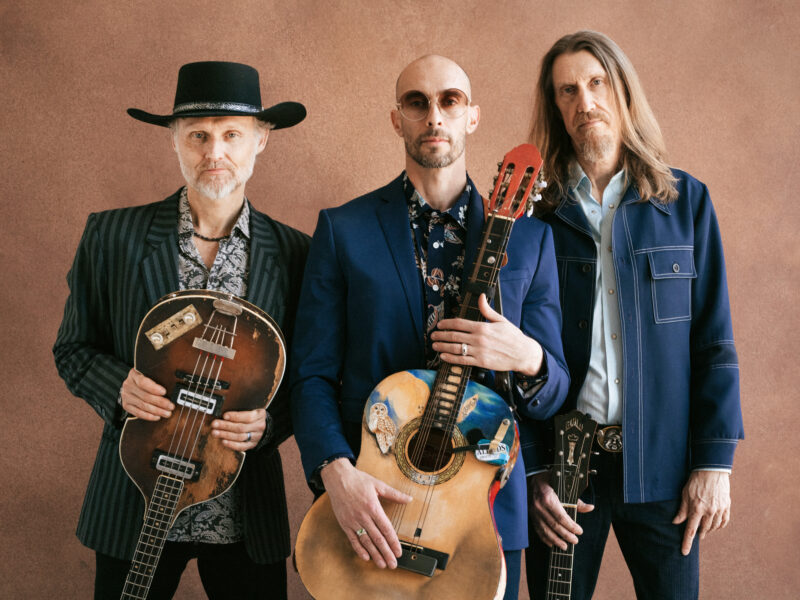
I sat down with multi-instrumentalists Jano Rix before his gig with The Wood Brothers at The Englert Theatre on November 12th. Touring in support of their new record “Puff of Smoke“, it has been a busy year for the Colorado based trio. Taking a beat to touch on what shaped him artistically, his favorite illustrators, and the impact dancing has had in his adult life, Jano let us into how he makes a chaotic world feel focused and comfortable.
Logan Melia: What are you drinking there?
Jano Rix: I’ve got a black tea, a Fiji tips out-of-the-box from out there.
Logan: Only the highest quality.
Jano: Only the highest quality with nothing in it. Half a cup of water because that’s what it was like.
Logan: You got to stay hydrated. Are you a coffee guy usually? Or are you tea?
Jano: I have coffee in the morning. In fact, my whole life until I don’t know, two years ago, I never drank caffeine.
Logan: Really? What changed?
Jano: I don’t know. I started to like getting an espresso, like something sweet, like that one. And then I was like, I literally said, maybe I’ll see what getting a habit is all about with caffeine. And it’s on. So yeah.
Logan: I just started like three months ago drinking coffee.
Jano: Really.
Logan: Yeah, like in college, I was like, I’m not going to do it because I can do it without it. I got this. And then over the summer, I worked at a golf course, and it was earlier mornings than I’ve ever had here at school. And that’s what made me fold. I’m a little disappointed in myself.
Jano: Yeah, you know, it worked. Getting the habit worked. I got it. The thing about it, though, is that, I don’t know, it doesn’t really work that great if you didn’t get enough sleep. It makes you feel awesome if you got enough sleep, it’s even better. And if you didn’t get enough sleep, then you still feel like crap but jittery.
Logan: Are you a full 8 hours guy or?
Jano: I’m in a stage where, yeah, that’s good. Seven and a half. Seven and a half.
Logan: You need it?
Jano: I need it. Yeah.
Logan: Do you feel like sluggish if you oversleep? Like if you are wiped, you sleep 10 hours, one day you wake up at, you know, 1130 A.M.
Jano: If I, well on the road, 11:30 is reasonable. But I, it’s like all about timing. If it’s, I do believe in sleep cycles, at least for myself. So nine hours is awesome. 10 hours would suck.
Logan: On the road, do you like the on the road thing? Does it mess with that schedule?
Jano: Oh, I mean, yeah. It messes with my schedule. Yeah, last night wasn’t so great. You know, it depends on how the roads are, if the bus is going to stop in the middle of the night to fuel up. it depends on a lot of things.
Logan: How long have you been touring for?
Jano: 25 years, maybe?
Logan: A little home on the road there, you know? You’re getting used to it. After the 25 years, maybe.
Jano: Yes, I’m definitely used to it. I’ll tell you what, when I went away in COVID, I did miss it after a while. I loved it at first, actually. That particular thing of not touring, it was so awesome. I was home for months. And then after a while, it was just a huge part of my life, my expression, and also just being used to just seeing new places and waking up in a new place. And just, I don’t know, we have a tour family. I really missed it.
Logan: When COVID first hit, were you like, I’m not going to do anything musical, I’m going to cleanse myself of this, or were the creative juices still kind of running for you?
Jano: Oh, I mean, that was not a point in my life where I was like, no, I don’t want to do something musical. I had a point in my life, a few years before that, where I decided to quit music as a profession and that didn’t last. All that did was let me know that it was what I needed to do. It was good in that way. I tried to be a carpenter and I started working and doing like construction stuff. Working for a company and I quickly realized this is cool, but no, I need to put everything into music so that I can figure out a way to make a living doing this. I forget what year that was. I mean, 2009, something like that. But what was your question? Oh, COVID. COVID. Yeah. No, but it was just, I was, you know, I could do without the travel. So like stopping travel. I mean, I also spend the other, part of my artistic life is mostly spent in the studio. And that was mostly gone, but then we started doing sessions with masks and stuff, but touring was dead for a while. And I do remember vividly the first tour date, this live show date.
Logan: What do you remember about it?
Jano: Oh man, I cried. Like it was really awesome. I think it was outside, indoor/outdoor, like trying to do the COVID thing. At City Winery in Nashville and I think, what was it? Gosh, I’m trying to remember. Was it an Oliver Wood? I think we did an Oliver Wood Trio solo gig. And Seth Walker also played that night, like a bunch of people I’ve worked with and our friends and musicians I love. And I just, we played our set and then I just remember that felt amazing. And then I remember sitting in the audience, standing by the soundboard and watching Seth play. And I was just like, I was just so struck and moved by like how lucky I am to know these people and that we get to do this and I get to hear this, like after not hearing anyone play live music for so long.
Logan: In those moments like that, is there like a song that kind of sticks with you from that exact time, or like maybe any other moments where you have a specific song that you remember hearing in a place during a time and you’re like, this is sticking with me?
Jano: Oh, for sure. I don’t know if I remember a specific song from that night, but speaking of, it might’ve been, because I remember this from Seth Walker, hearing him, “Grab Ahold” which we’ve also done with the Oliver Wood solo stuff that I worked on. And I guess I worked on the original Seth Walker recording of that too. And he wrote that with Oliver and Oliver produced that first album and then I produced the subsequent ones. So I don’t know, that song goes way back and I’ve just, what really struck me, what I’m thinking about is hearing him from across festival grounds. Playing a daytime set, which can be tough in a festival early on, and telling a bunch of people there who didn’t know Seth, I was like, you have to go see Seth. And walking over to the stage and he was on the main stage and it was just like, you know giant fields, sun beating down, and he had everyone transfixed. Like you could hear a pin drop. When he gets into it, it’s remarkable. So I don’t know, there’s one. There’s one, yeah.
Logan: You mentioned kind of coming out of your little, I’ll say, hiatus/retirement and realizing that you needed to do it more and more. When did you first realize that you needed to do it? Do you remember like how old you were or, you know, what’s really solidified that?
Jano: I guess I wasn’t like a lot of people who were like, maybe, you know, they got a guitar in high school or something and they’re like in love with it. And I’m like, I think I want to do this because it was around me since I was a kid. My dad’s a professional drummer. And so I grew up, you know, from the time I was tiny, watching him play gigs. And like, there was a, I heard a cassette years ago of me playing when I was 4, playing and singing, and I was like that’s pretty good. I don’t really think I’ve gotten that much better from a four year old, I was just improvising a blues. My parents, they were outside and I went in the basement and just pressed record on a tape deck. And I played and made-up a blues about being all alone in the house, where they were and what they were doing. My dad’s in the shed, my mom’s out working in the garden and like.
Logan: And here you are, all alone.
Jano: Yeah. So I kind of, I wouldn’t say I knew I was going to do it because I was also, my mom’s a painter and I drew and painted growing up like equal time to music. So it was like, if I wasn’t skateboarding or something like that, because I also like to do athletic things, but I was drawing, painting, or working on music, piano or drums, mostly drums. So I don’t know, it was kind of bred into me.
Logan: Who were your favorite artists or painters?
Jano: My favorite artists or painters, here’s an inside one, Frank Frazetta. He did a lot of illustration, like he did a lot of book covers. My mom was really into illustrators and he was very much in a kind of fantastical fantasy sci-fi style, but fantastic craftsman and fantastic painter. Anyway, that’s kind of a random one to pick out because a lot of the greats I love too. I remember becoming obsessed with Picasso for a while. But yeah, I just saw someone wearing a Frank Frazetta t-shirt and I was like, where’d you get that? And she’s like, there’s this museum. I was like, you went? You know, it’s very inside, but in Pennsylvania, there’s just this Frank Frazetta museum. Yeah, so I don’t know. I was very, you know, that was another thing like my parents, my mom passed down that kind of stuff to me. So just, yeah, a bunch of illustrators I was into. That was a great one.
Logan: Were you in the comic books at all?
Jano: I wasn’t. I wasn’t, but I had a friend who really was, so I gained an appreciation of that. Actually, his name is Ben Mara, Benjamin Mara, and I was just seeing, he does amazing comic book stuff now. Really? He’s in it. He followed it all the way through. So I got an appreciation for what that was at the time, but no, I guess just more kind of like fine art stuff and painting. I don’t do too much of that. The most is like, people are like, Who painted that on your ‘shituar’? It’s like, Oh, I just did that. Randomly every few years, I’ll get the bug and I’ll like paint an owl on my ‘shituar’ or something.
Logan: There you go, an owl on your ‘shituar’. Yeah. You mentioned skateboarding a minute ago. Now, when I think of a kid skateboarding, this music isn’t exactly, The Wood Brother’s isn’t exactly the music that comes to mind. So were you skating, listening to Rancid, or were you skating, like listening to John Prine?
Jano: We were totally listening to The Misfits. You know, I think musically I had my own thing, but I was on the edge of that skate culture. So I did listen to that stuff. But musically, I was always kind of like, not with necessarily what my friends were listening to, because I had a very focused musical life and stuff I was into. I went through some phases with friends around, but I was really into Pink Floyd at that time. Like really, really into Pink Floyd.
Logan: I was never a Pink Floyd guy. Me and some buddies put on The Wall for the first time I ever heard it. And it was a life-changing experience. You feel it over your whole body. It just washes over you.
Jano: That’s cool to hear how someone else felt. I’ve never talked to anyone about what they thought of The Wall the first time. But yeah, I used to, I mean, I was young and I used to watch that movie. I didn’t know what the hell was going on in that movie. But it was like a feeling and they just were able to conjure certain feelings. And when I look back at it, they’re very patient. That music often moves very slow and there’s 16 measures, 32 measures in the middle of a song of just the groove vamp with maybe like 3 guitar licks. It’s like so patient and there’s so much space. And I think I’ve always gravitated to stuff like that. whether it was that or more funky music. Yeah.
Logan: Do you feel like you incorporate some of that patience into your own music?
Jano: I do. I don’t think about it consciously much. But if anything, like in the confines of making a record maybe, sometimes I listen back and I’m like, oh, I need to like, hit it a little harder sooner because there’s not enough time to be just patient. But I don’t think about it. It’s something that’s kind of automatic for me, I think.
Logan: We talked about your mom’s influence a little bit. You were putting together an album with your father. Legacy. Not a whole lot of musicians are able to do that, you know? So I mean, obviously, I’m sure it feels incredibly special. But is there anything in that album that you just haven’t felt before while making music?
Jano: Oh, good question. Yes. You know, and I don’t know if it’s purely a musical thing as far as like the aesthetics of the music, like the musical choices. But it felt very difficult. different to make that record. I make records all the time. I’m very lucky to have been doing that for a long time. Either as a musician or a producer and we have our studio, you know, me and The Wood Brothers in Nashville. But making a record with my dad was, I think I put more pressure on myself. Not that it had to be, it’s not going to be, I didn’t care if it was a commercial product, but it was just, it just felt more like, I don’t know, I wanted it to be good. I wanted him to like it. I don’t know. It was just, it was harder for me to finish it. I found myself dragging my feet, which is part of, I blame myself partially. We’re equally to blame why it took us 12 years from our first notes put down and recording to the end.
Logan: During those 12 years, were there any songs that you were able to get down in a day or get a good chunk of it down? Or were they all really laborious?
Jano: Oh, I mean, in the end, I mean, we only had maybe five times we ever got together and recorded. I’d say probably 5 days. Total.
Logan: To make an album, that’s a pretty good time to make album.
Jano: There was a lot, okay, but there was a lot of… I spent other days myself, but I erased a lot of it because what we would do is we’d get together, the first time we got together at Southern Ground Studios in Nashville, and we spent an entire day, maybe it was two days, I think it might have just one day, and we tracked basics, just the two of us for, I mean, it’s only the two of us playing everything on the record. Yeah. And we got like half the record done that day. And then another day in the town where my parents live in New York, I went up there and we tracked again. We got basically the other half of the basic the tracks done. And then overdubs, I would work on them like in Nashville and I would add a lot. And in the end, it was just like, a lot of times I just stripped it back to mostly just me playing like a Fender Rhodes, my dad playing drums, our vocals. No, it can’t have been five days. I’m going to give us seven days, but totally working together. But I worked I worked a lot of other days on it myself, just adding little things, taking things away.
(Part 2)
Logan: Do you think you work best with simplicity?
Jano: Yeah.
Logan: In your dream scenario, what are the only things on a record or on a song? What’s the core that can’t be stripped away for you?
Jano: Well, it could be anything. It could be anything, but I find myself often, like my favorite record by an artist is one with usually with like very little production. Sometimes there’s no crumbs on it, sometimes there’s, you know, not like the instrument I play like I necessarily care about hearing, you know. Like a Dylan record, like a really old one. That is just mostly just him. Yeah. Like, I’m like, oh, it’s not. No offense to my dad who played on Dylan Records.
Logan: Your father played on Dylan Records? Which ones?
Jano: The most known recording would probably be “Hurricane” or “Desire”. And he played on “Desire”, he’s playing with congas on that.
Logan: That’s wild. You ever get to meet Bob?
Jano: Unless I did when I was really tiny, no, but I heard plenty of stories.
Logan: Any ones you can share?
Jano: Oh man, my dad was on the Rolling Thunder Revue. Yeah, if you know that one, it’s like, that’s just a wild tour. Dylan was, I think the cool parts about it, some of the cool parts are he was tired of, he was such a big star at that point. He felt like his fans didn’t necessarily get tickets to the shows because everything was becoming expensive and would sell out right away. So he decided to do a tour, but not book it ahead of time. And he just got some buses, put the band together, because him and Rob Stoner put the band together. And they would just, as I know the story, show up in a town like the night before and just say, hey, we want to play your venue here like your veteran’s hall or something like that. And they would just put posters up, said Bob Dylan playing tomorrow night. And so it was very, to use the term freewheeling, and like, you know by the seat of their pants. And on that tour he kept adding artists and buses, just like pick up people. And then suddenly Joni Mitchell’s on the tour and Alan Ginsberg’s on the tour and like everybody’s on the tour. And it was, you know, so it was like this crazy social hang and wild tour, you know.
Logan: That’s crazy. Is that something like, is there any off the wall ideas that you would ever want to do as an artist? Anything like a tour where you got, you got no direction in mind?
Jano: I have, yeah, I have fairly ambiguous ideas that I haven’t really locked down of because I dance a lot. I don’t know if a lot of people know that, but like I teach dance. My wife and I teach Casino and Salsa. Casino is often called Cuban Salsa. But just through that world and interacting with music that way, I would love to incorporate that heavily for the audience into a set, as well as participating in rhythms in the music more than just clapping along every once in a while. Which goes to your question of, which I think this started out with a while ago, of what are the elements that you can’t get away from in music? And there’s a style of music that I really like, Cuban Rumba. And I love Huapango. And in Huapango, it’s just percussion and vocals. And man, music does not need any more than that. When anything’s grooving that hard, you do not need anything else, and all the space is wonderful. That said, I love guitars and keyboards and bass, but I love the simplicity of it too. I think that’s, and the rhythmic grooving nature of it. So I would just, and there’s something, our culture doesn’t have a lot of participation either. in dance socially, at least not white people. So social dances, that’s like, hardly anyone knows how to do those anymore, like partner dancing. But even just dance as a celebration and a ritual. And dance classes are for kids, you know, and then adults, unless they like to go to concerts and dance, they don’t really dance. So I would love to incorporate that, as well as, I think, everyone can play and sing and do music. It’s just like we’re not raised with that as part of our culture. And man, it’s very healing for people to do that. So I’d like to incorporate that.
Logan: I remember hearing one time, one of my, I took choir in high school and a teacher said, singing and dancing is like running. Everybody can do it. doesn’t matter how good you are at it. And do you find that there’s a level that people need to cross them to be more comfortable dancing and doing that stuff? Do you find that there’s a switch that needs to be flipped because like, I think the average person isn’t maybe comfortable or think they’re capable of dancing. So is there some threshold that they need to cross, do you think?
Jano: It depends on the person. Because in a way, no, because a little kid can do it. And a little kid can play and sing music and it’s perfect. It’s just what it should be. But I was that person who, I grew up on the bandstand on stage, I did not step foot, I did not dance until I was an adult. I was deathly afraid of dancing, which is probably why I got so into it once I conquered that fear of it, why it made such a difference to me. But yeah, so I was one of those people. It was not in my culture. And I was really afraid of dancing. And then my wife, we went to the Dominican Republic and we took some little dance lessons on the beach. We did some bachata lessons. And then we got back home and she’s like, I really want to take salsa lessons. And I was like, okay, I’ll go with you. And so we went week after week, I was kicking and screaming every week. I did not want to go and be bad at, because I was used to being good at art from the time I was little. I was like, I was like the one who was really good at the art, you know? And here I was terrible. I was terrible at dancing. And salsa requires, you know, a vocabulary, it’s a language. But once I finally got over myself and went to a social, which everyone told me to do, and just dance with people, which I was afraid. I was like, no, I’m going to get good first. They’re like, no, you’re not. You have to go and that’s going to make you get good. You just have to go and suck and dance with a lot of people. When I finally did that, I was so hooked.
Logan: Really?
Jano: Yeah, because you are basically dancing duets with different people all night. You’re improvising. It’s like a full body improvisation with music and another person. It’s just like a beautiful connection. It breaks the boundaries of physical connection. We don’t really touch much in our culture, except like with your lover. That’s it. Like otherwise you don’t really touch, you know, you pat your bro on the back. That’s that, yeah, that’s that. So yeah, it was like really opened my world and it was whole, opened my world to new cultures, new language, and the language of dance. So I don’t know, yeah.
Logan: You mentioned it being like a full body, like experiencing that thing. Do you feel the same way when you’re on stage doing music? And is that, if it is, is it the same use of your full body or is it a different feeling?
Jano: It’s a different feeling, but it can be very much the same and it should be. And dancing has informed me with my music because my music, has been a professional thing for so long. And in a lot of ways, I put pressure on myself since I was pretty young to perform at that. But dancing started as an adult, and I got to watch myself as it was like a third space. It was not, for a long time, it wasn’t professional and I became professional. And I also saw what that did to my experience of it, you know. And, but it made me aware that I was missing out on some of the joy I originally had in music. Because dancing, and I was like, I couldn’t believe I’d become this person who would just be like, no one on the dance floor, that’s me. You want to dance? Let’s go. I had no problem asking, going to an unfamiliar city somewhere in Europe and meeting everyone, asking them to dance. And it was just with so much joy, like that connection, just the joy of connecting in the moment to just that life between the two of you, between the music moving in the air. And so, yeah, you should have that with music too. And it is a full body experience. Even if you’re playing an instrument that mostly just your fingers touch some keys or something, your whole body’s involved, your breathing’s involved, you can dance with it.
Logan: Do you feel like that kind of the love, that you’re describing, do you feel it growing every time you do it? Or do you find it to be maybe a little repetitive at times?
Jano: Well, yeah, it goes through phases and it’s night to night and it’s moment to moment. And I think once you’ve done it long enough, at least for some of us, the only thing to really think about is to notice where you’re at. The music’s happening, like you’re playing the music, thinking about what you’re going to play next is a complete waste of time. Your conscious brain is really way too slow to do all the cool things that you can actually do. But you just kind of realize where you’re at, like, oh everything’s feeling hard. I’m feeling like I can’t hear, I’m annoyed with my in-ear mix, okay where am I at? Like, how am I feeling? Where is this in my body? Can I breathe? Can I just get curious about the sounds and where I’m at? And kind of sometimes I look at the lights in the room and that’ll like bring me back. I think you go through stages too, where it’s like all joy and you’re just excited about it. And then I noticed myself with dance and then I got a level of expertise with it, and I started teaching as people start looking up to you. And then you feel like you’ve got to be somebody. Like when you dance, people are watching you. And you’ve got to represent and you’ve got to, then the joy is gone. And you still might do some hot dance moves, but you’re not really connecting with your partner, you’re not really letting loose in the moment, and you’re not even modeling what you should be modeling. You’ll look back and you’ll, if people videoed you, see you’re not smiling.
Logan: How do you kind of disperse those expectations? When you feel them setting it, is there anything you do to make them go away?
Jano: You schedule therapy.
Logan: Not bad advice.
Jano: Yeah, you know, and I don’t think there’s one solution, but over time, you get different home mantras to tell yourself. If you can remember to remember, then you, like this week I’ll tell you what it is this week on stage, it’s someone talked about curiosity. And so I just like try to get really curious. I mentioned that a few minutes ago, just get really curious about the moment. That’s what I’ve been doing this week, that word comes to mind. In fact, I wanted to paint it on one of my instruments, so I just see it. But I remember last week, I put a little, preparing for the tour, I put a little sign, put it on my rig, and it said, I think, smile, like smile with your body. And when I think of that, my posture gets better. My posture tends to smile and my chest comes up and I tend to breathe in. I smile with my face. And I realize, like, what are you practicing? Are you practicing being stressed out and worried about screwing something up and not being able to, not having your chops up for this tour? Because that’s how you’re going to feel on the tour. No matter, if you practice that for 1000 hours before the tour, you will still not feel ready for the tour, no matter how good your chops are because that’s what you practiced. So try to practice letting it flow and being curious and interested in the sounds as they happen, rather than trying to turn yourself into a machine, being constantly looking for your own faults. Because I can do that. I’m good at that. I spent years doing that. I can play like a machine, I know how to.
Logan: But it’s better if you let it flow.
Jano: Yeah. And you can. There’s machines, I mean, you can just have it tell AI to do it now. I think it can make you machine music.
Logan: It’s not good music.
Jano: It’s not good music, but it sounds, honestly, it sounds like lackluster music and a lot of people make lackluster music because they’re trying to treat themselves like machines. We’re lucky that’s not what our fans want. At least not with the Wood Brothers. Like they want to hear, like have a human, you know, they always say, God you guys sound so honest. I think it’s, we just let ourselves be what we are, you know, warts and all.
With support from Irish duo DUG, The Englert was lively for The Wood Brothers. For over two hours, fans were showered with songs old and new with an encore of their hit “Luckiest Man”. It was a busy year for Rix as The Wood Brothers dropped their new album “Puff of Smoke” in August and “Legacy, Vol 1” from Jano and his father released in November. The Wood Brothers will continue their tour this winter, you can find dates here.